
Last updated September 20, 2026
Full 25-point door and opener safety check with every visit - springs, cables, rollers, tracks, and your LiftMaster or Chamberlain opener included
You get a price before we start. It does not change when the truck arrives.
 Before
 After
After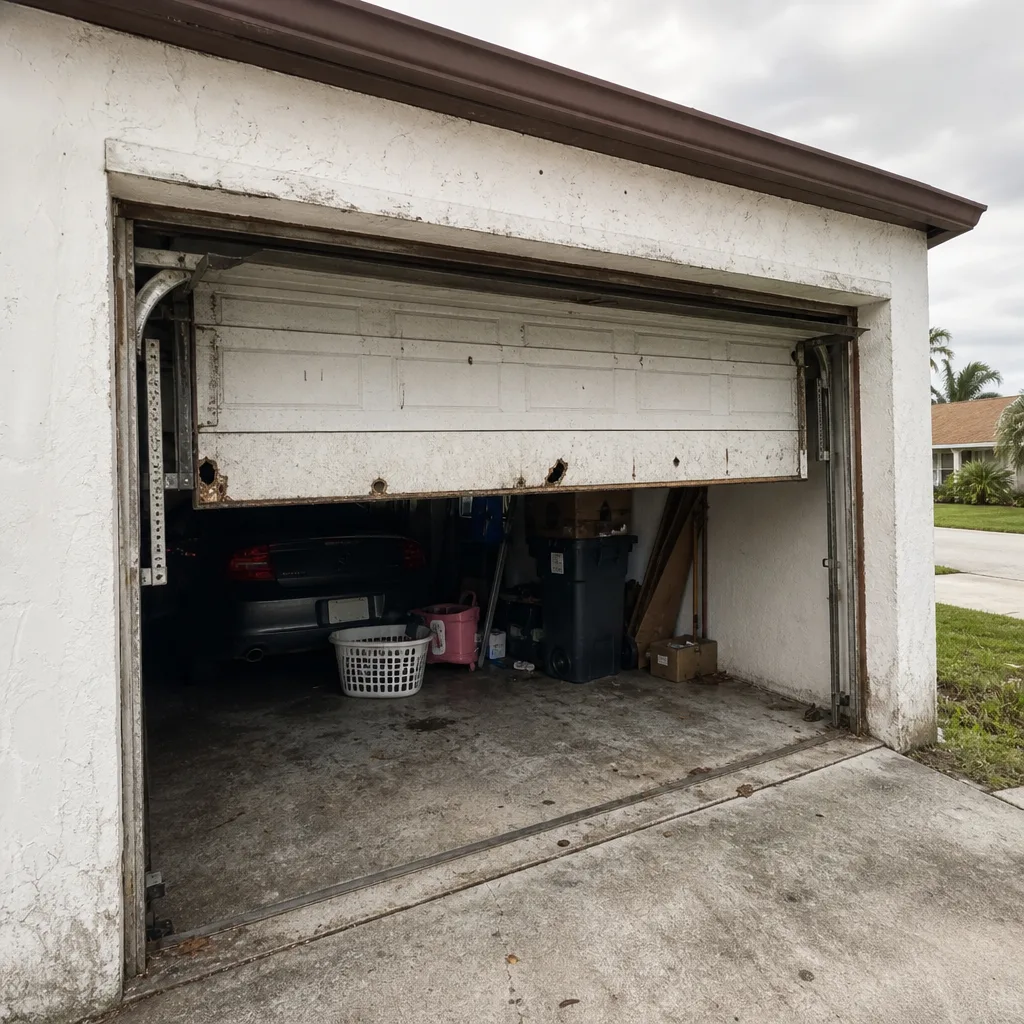 Before
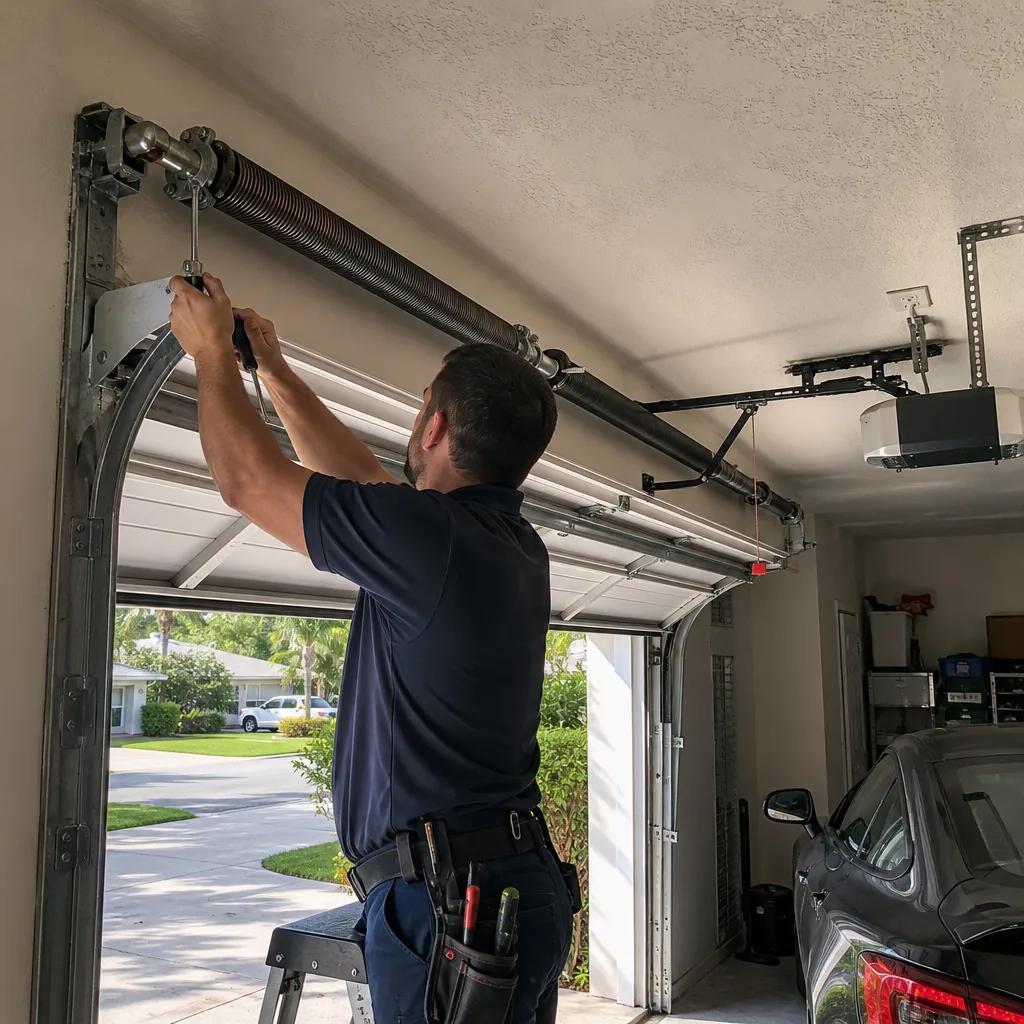 After
After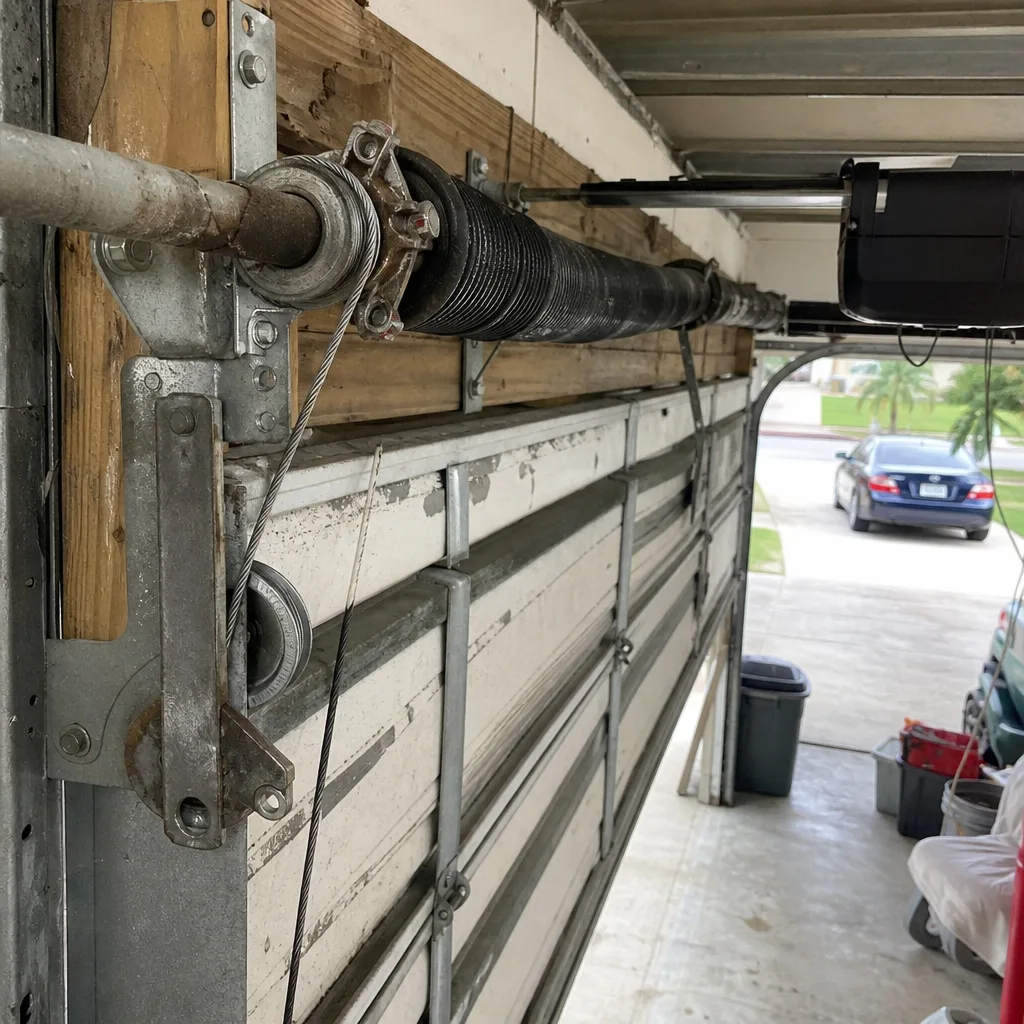 Before
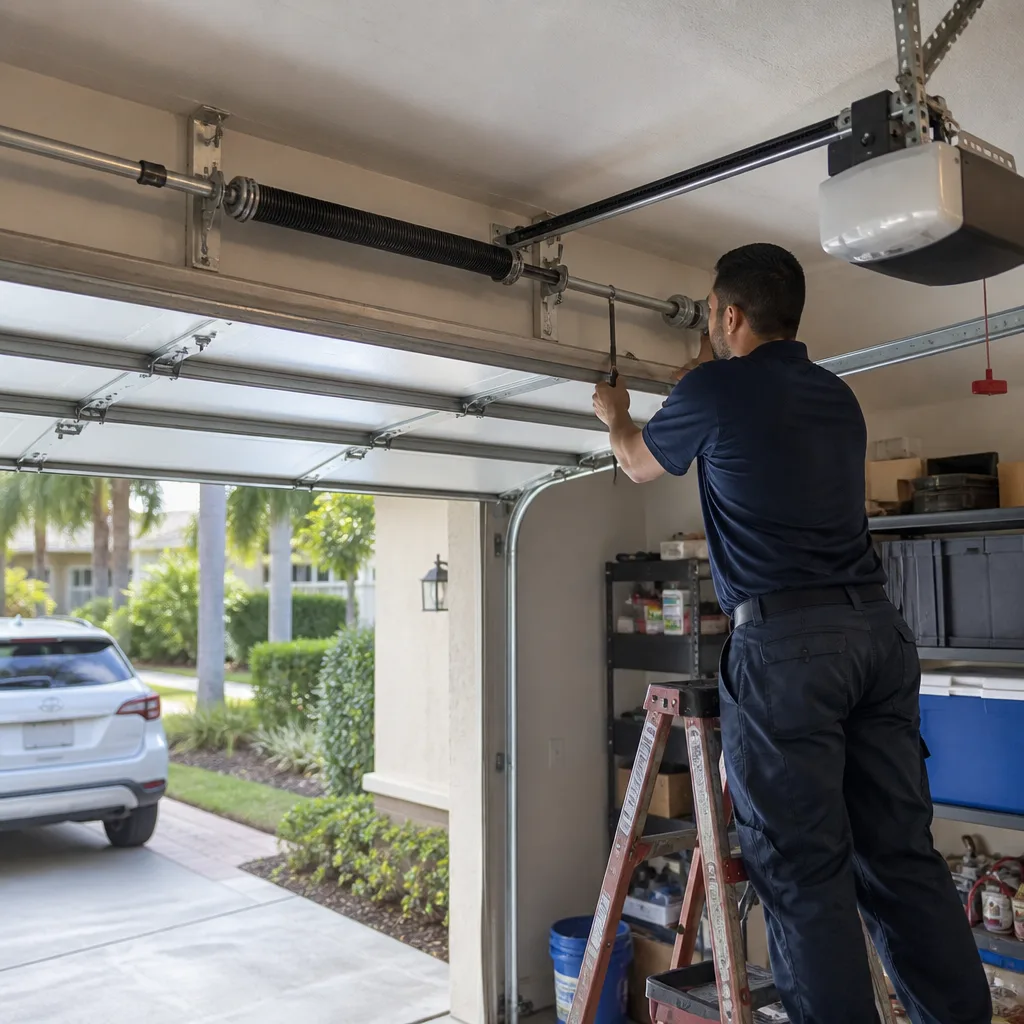 After
AfterGarage Door Warning Signs: A Hollywood Homeowner’s Reference Guide
A garage door that takes 1.2 seconds longer to close than it did six months ago is not “getting old.” It is a specific symptom: the opener’s force-limit setting is compensating for friction from worn rollers, and the motor is absorbing the load the rollers should be carrying. Most Hollywood homeowners don’t notice the change because it happens gradually, week over week, until one morning the door won’t open at all and the repair bill arrives as a surprise. This guide names the warning signs precisely, explains what part is failing in plain language, and tells you what a technician should be looking for when they arrive at your door in Hollywood. For a broader overview, see The Complete Guide to Garage Door in Hollywood.
Quick Answer
The most common garage door warning signs in Hollywood are a door that moves slower than it did six months ago, a grinding or popping sound during operation, visible sag or misalignment when the door is halfway up, and vibration you can feel through the ceiling or wall when the opener runs. Each of these maps to a specific component: worn rollers, a cable seating incorrectly in its drum, a spring losing tension, or loose mount bolts on the opener rail. If you can name the symptom before you call, you can ask the right questions when the technician quotes the repair. If you’re not sure where to start, read How to Hire a Garage Door Contractor in Hollywood: A Step-by-Step Guide.
Table of Contents
- The Sound Taxonomy: Grinding, Popping, and Banging Mean Different Things
- Visual Alignment Tells: What a Crooked Door Actually Indicates
- Speed Changes as a Diagnostic Signal
- Vibration Transfer: When the Opener Shakes the Ceiling
- Hollywood Humidity: Why August Mornings and January Mornings Behave Differently
- Cable and Spring Wear: The Components That Fail Spectacularly
- Opener Behavior: Reversing, Short-Cycling, and Logic Board Fatigue
- Common Mistakes to Avoid
- When to Call a Professional
- Frequently Asked Questions
- The Bottom Line
BeforeAfterThe Sound Taxonomy: Grinding, Popping, and Banging Mean Different Things
A garage door in good condition makes a consistent, low mechanical sound: the opener motor humming, the rollers turning in their tracks, the chain or belt moving along the rail. When the sound changes, the change is diagnostic. We tell Hollywood homeowners to listen for three specific sounds, because each one points to a different failure mode and a different repair cost.
Grinding is metal on metal. The most common source is a roller whose ball bearings have seized or worn flat. Instead of rolling, the roller drags against the inside of the track, and the sound is a rough, scraping grind that gets worse as the door moves. Left alone, a worn roller will eventually wear a groove into the track itself, which turns a $20 roller replacement into a track replacement. The second source of grinding is a drive chain that has lost tension and is dragging against the rail underneath it. A LiftMaster or Chamberlain opener with a chain drive will produce a metallic rasp when the chain slack is no longer within spec.
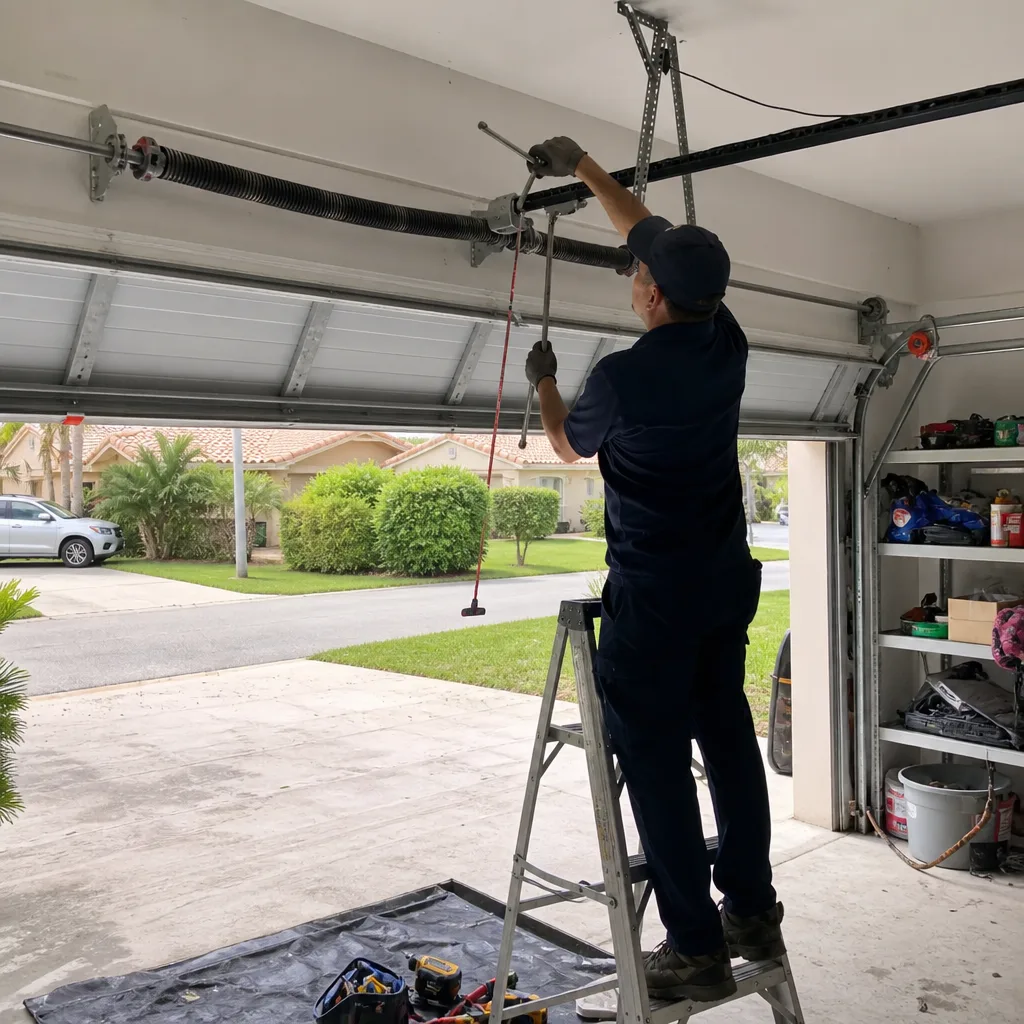
Popping is a cable event. Garage door cables live under constant tension and ride in grooves machined into drums at each end of the torsion shaft. When a cable loses a fraction of its seating, the strands can momentarily climb out of the groove and snap back in, producing a sharp pop. This is common on doors that have been hit by a car bumper or have shifted slightly out of square. A popping cable is not a cable replacement yet. It is a warning that the cable is working its way toward a full derailment, and once a cable derails, the door will not lift evenly.
Banging is the sound of a torsion spring releasing its stored tension all at once. If you are home when it happens, it sounds like someone dropped a toolbox on the concrete floor of the garage. The door will often jump or shudder. After a spring breaks, the door might still open if the opener is strong enough, but it will be unbalanced and dangerous to operate. In Hollywood, where many homes have attached garages directly under bedrooms, a spring break at 6 a.m. is a common first sign that something was already wrong.
The reason we describe sounds this precisely is that a homeowner who calls and says “it’s grinding” gets a different technician conversation than one who says “it’s making a noise.” The first call leads to a quote for rollers and a track inspection. The second leads to a diagnostic visit. Precision saves you money.
Visual Alignment Tells: What a Crooked Door Actually Indicates
Stand in your driveway in Hollywood and look at the door when it is halfway up. If the bottom edge is not parallel to the garage floor, the door is out of alignment, and the direction of the tilt tells you which side is failing.
If the door sags toward one side, the cable on that side has either stretched or slipped a groove or two on its drum. Torsion spring systems use paired cables that must remain exactly equal in effective length. A difference of one groove on the drum is enough to lift one side of the door an inch higher than the other. The cable on the sagging side is carrying less tension, which means the opposite cable is carrying more, and that overloaded cable is now the one most likely to snap.
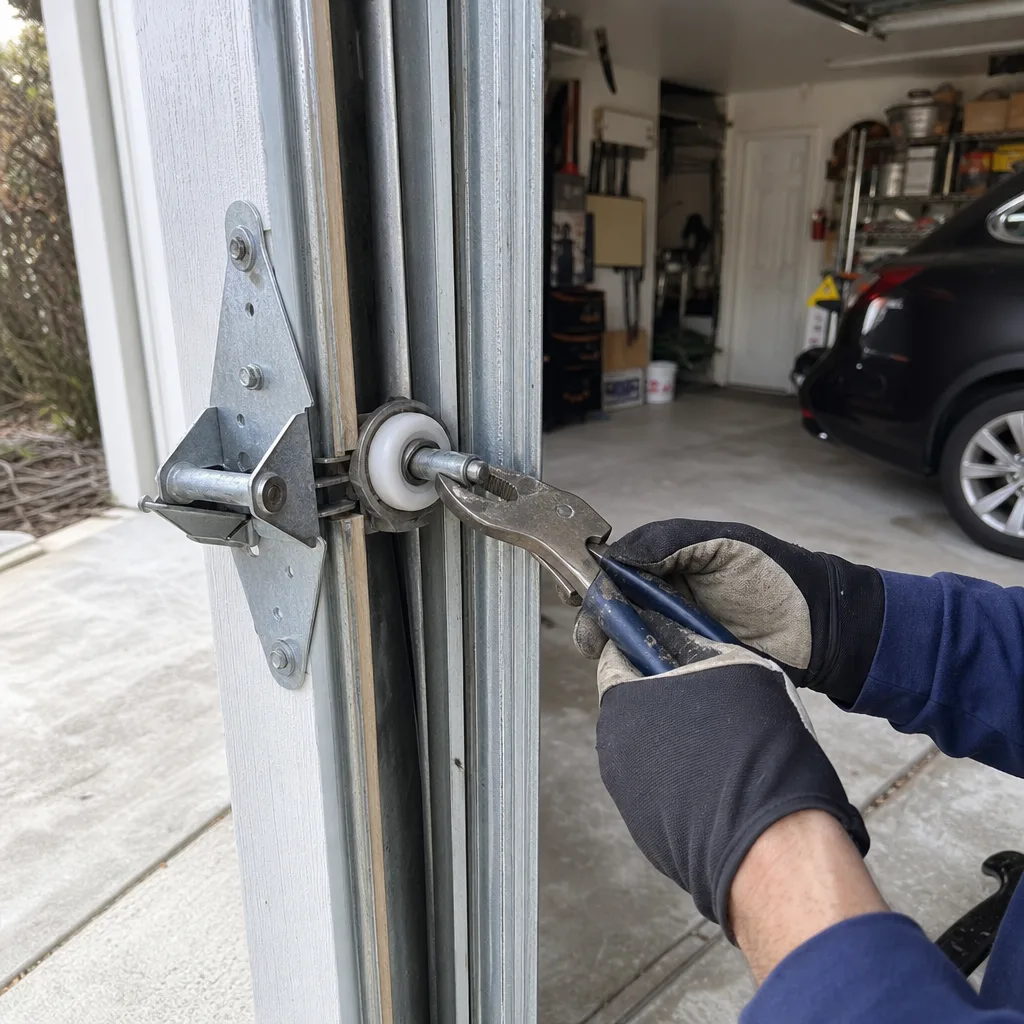
If the door appears twisted, with one panel slightly rotated relative to the one below it, the issue is usually a failing hinge or a loose track bracket on one side. Garage door hinges are graded by panel position: the bottom hinge carries more load than the top, and the bottom hinges fail first. A twisted panel is often a hinge that has worn its pivot hole into an oval shape.
If the door leans outward or inward at the top, the track itself has moved. In Hollywood, this happens for two reasons: the track bracket bolts have loosened from vibration over years of operation, or the door was backed into at some point and the track was knocked a few degrees out of vertical. A track that is out of alignment by even a quarter inch will cause rollers to bind, and the opener will push harder to compensate.
One test we recommend: open the door halfway and let go of the manual release handle (with the door disconnected from the opener). A balanced door will stay in place. A door that drifts down is losing spring tension. A door that drifts up is over-sprung, which usually means someone replaced a spring with the wrong size. Neither condition corrects itself.
Speed Changes as a Diagnostic Signal
Every garage door opener is designed to move a specific line speed, measured in inches per second. For most residential doors, that is 7 to 8 inches per second. The speed does not change because the opener is aging. The opener is a motor, and motors either turn or they don’t. If your door is moving slower than it did when it was installed, the motor is working against something.
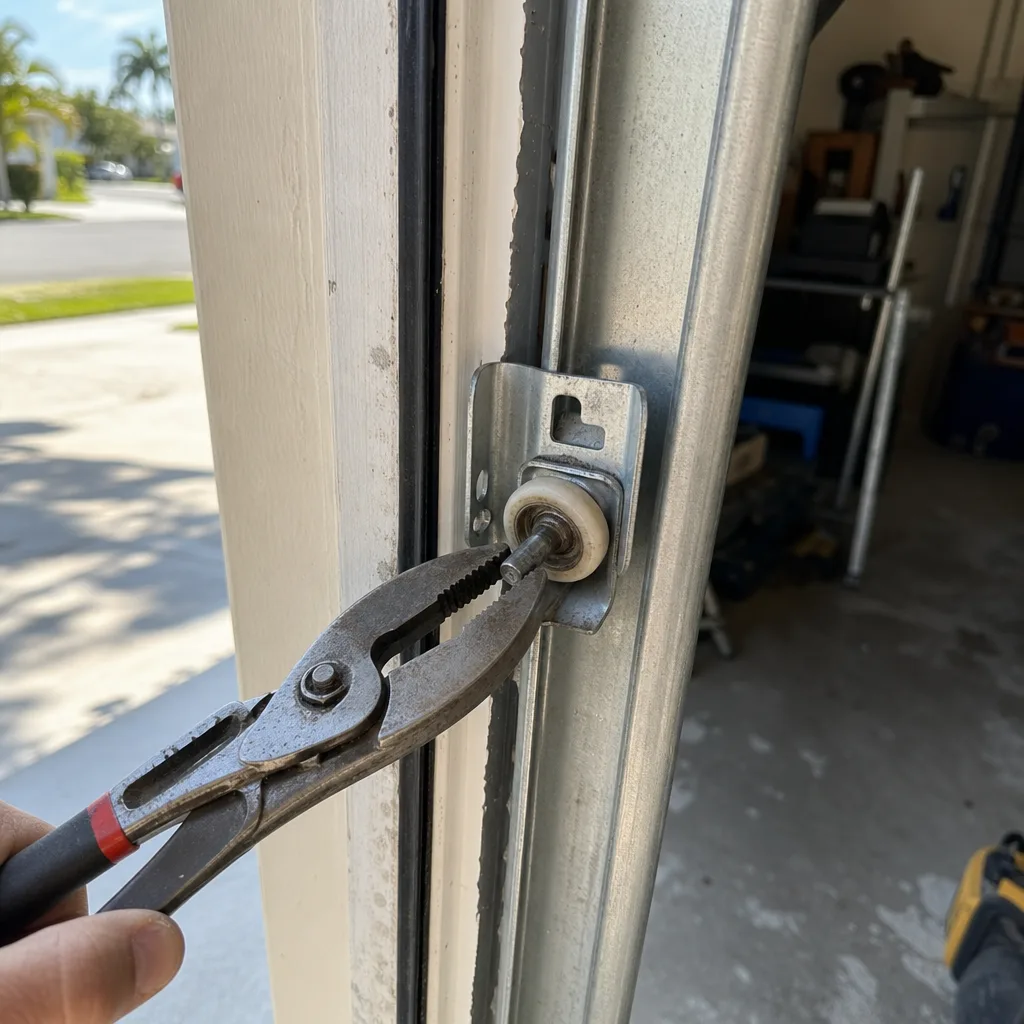
The most common source of added resistance is roller wear. Nylon rollers with sealed bearings roll freely when new. After 8 to 10 years of Hollywood humidity and daily cycles, the bearings dry out or the nylon wears flat, and each roller adds a small amount of friction. Ten rollers each adding friction is enough for the opener’s force-limit setting, which is adjusted at the opener unit, to push harder. The result is a slower door and a motor running hotter than it should.
The second source of added resistance is the door’s own weight geometry. A door that has shifted slightly out of square will bind its rollers against the track at a specific point in the travel, usually mid-cycle. The opener will slow at that point and then speed up past it. If you watch the door and see a hesitation at the same spot every time, the door is binding, and the binding point is where the technician should look first.
The diagnostic principle is simple: a door that moves slower than spec is a mechanical warning, not an age indicator. Compare your door’s current speed to a phone video you took when the house was new to you. If the difference is visible, something has changed. Fix it before the something fails.
Vibration Transfer: When the Opener Shakes the Ceiling
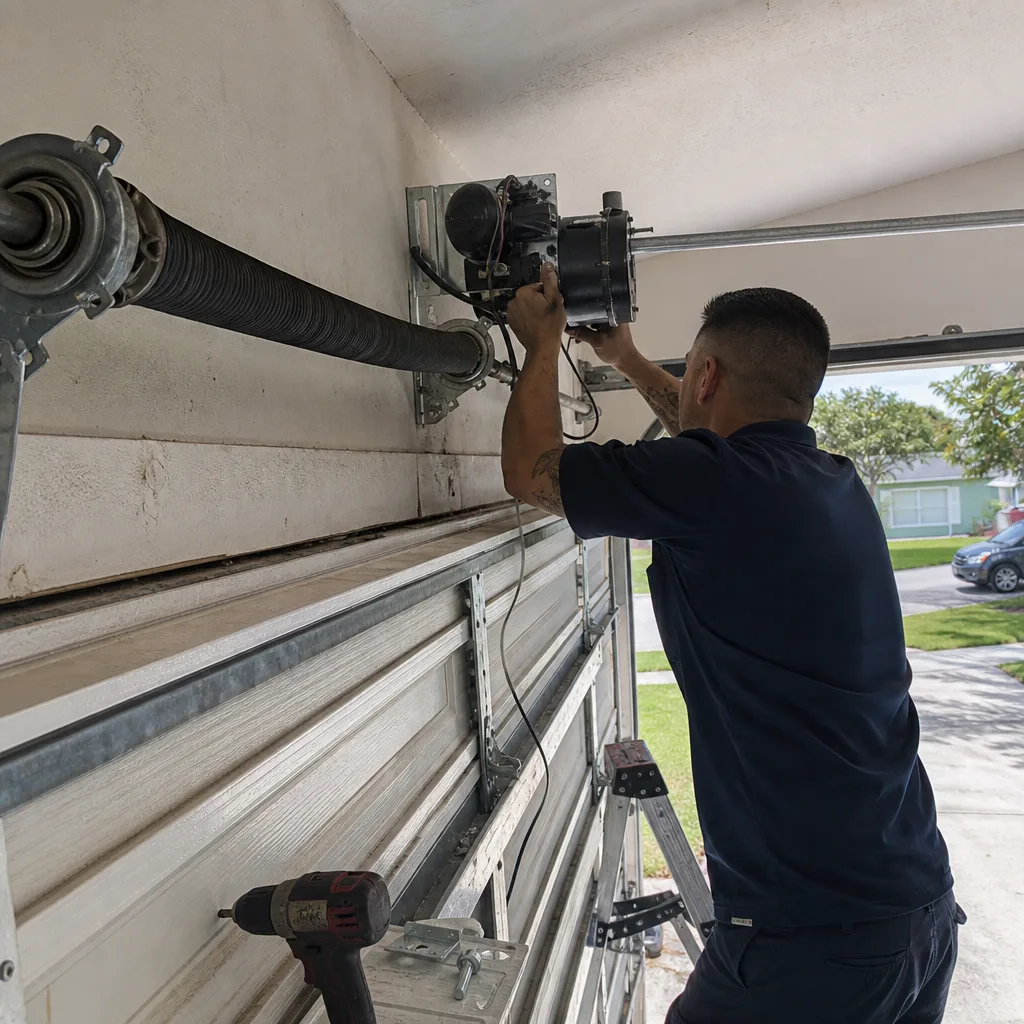
Garage door openers are mounted to the garage ceiling on steel angle brackets. The entire operating force of the opener is transmitted through those brackets into the ceiling structure. When the mount bolts loosen, even slightly, the vibration that should be absorbed by the opener’s own frame is transferred into the ceiling joists, and you feel it.
In our experience in Hollywood, the first report is usually a rattling sound in the room above the garage, or a subtle shake in a ceiling light fixture. The homeowner assumes the opener is failing, but the more common cause is the mount. The bolts that hold the opener to the angle iron work loose over thousands of open and close cycles. Tightening them is a ten-minute job. Ignoring them means the opener eventually sags, the rail loses alignment with the door, and the opener’s drive gear grinds itself down.
The second component to check when vibration appears is the drive chain or belt tension. A chain that is too loose will slap against the rail and send a pulsing vibration through the entire assembly. A belt that is too tight will do the same thing, but at a higher frequency. Both conditions are adjustable. A LiftMaster or Chamberlain opener will have a tension adjustment on the rail. A Genie screw-drive opener, which uses a threaded rod instead of a chain or belt, will vibrate when the screw is dry and needs lubrication.
The test is simple: place your hand on the opener housing while the door is moving. You should feel a steady, smooth vibration. If you feel a rhythmic thumping or a sharp buzz, something in the drive system is out of spec. It is worth having the mount bolts, drive tension, and rail alignment checked before the opener itself is condemned.
Hollywood Humidity: Why August Mornings and January Mornings Behave Differently
Hollywood’s climate does specific things to garage door hardware, and the symptoms shift with the seasons. This is a section most national guides get wrong because they are written for dry climates.
August mornings in Hollywood mean high humidity and a garage that has been closed all night. The humidity settles into the hardware. Door panels made of wood will swell slightly and gain weight, which increases the load on the springs and opener. Steel doors will not swell, but the hinges and roller bearings will collect condensation, and the rollers will run rough until the door warms up. The symptom is a door that is stiff first thing in the morning and smooth again by midday. If you notice that pattern in August, the fix is usually routine: clean and lubricate the rollers, hinges, and bearings with a silicone-based lubricant. Stiffness that does not improve by midday is a mechanical issue, not a humidity issue.
January mornings are cooler and drier, which is actually when we see more spring failures in Hollywood. Torsion springs are under constant tension, and the metal in a spring expands and contracts with temperature changes. After years of daily cycles in a humid coastal climate, the spring steel has micro-fractures that temperature stress can propagate. A January morning cold snap is a common time for a spring to let go. If your door feels noticeably heavier on a January morning, the spring is likely losing tension, and it is worth having it measured.
The point is that the same symptom, a door that is harder to open in the morning, means different things in different seasons. A Hollywood homeowner should track when the stiffness appears, not just that it appears. That timing detail saves diagnostic time.
Cable and Spring Wear: The Components That Fail Spectacularly
Every part of a garage door system that moves will eventually wear out, but cables and springs are the two components that fail violently, and the warning signs deserve their own section.
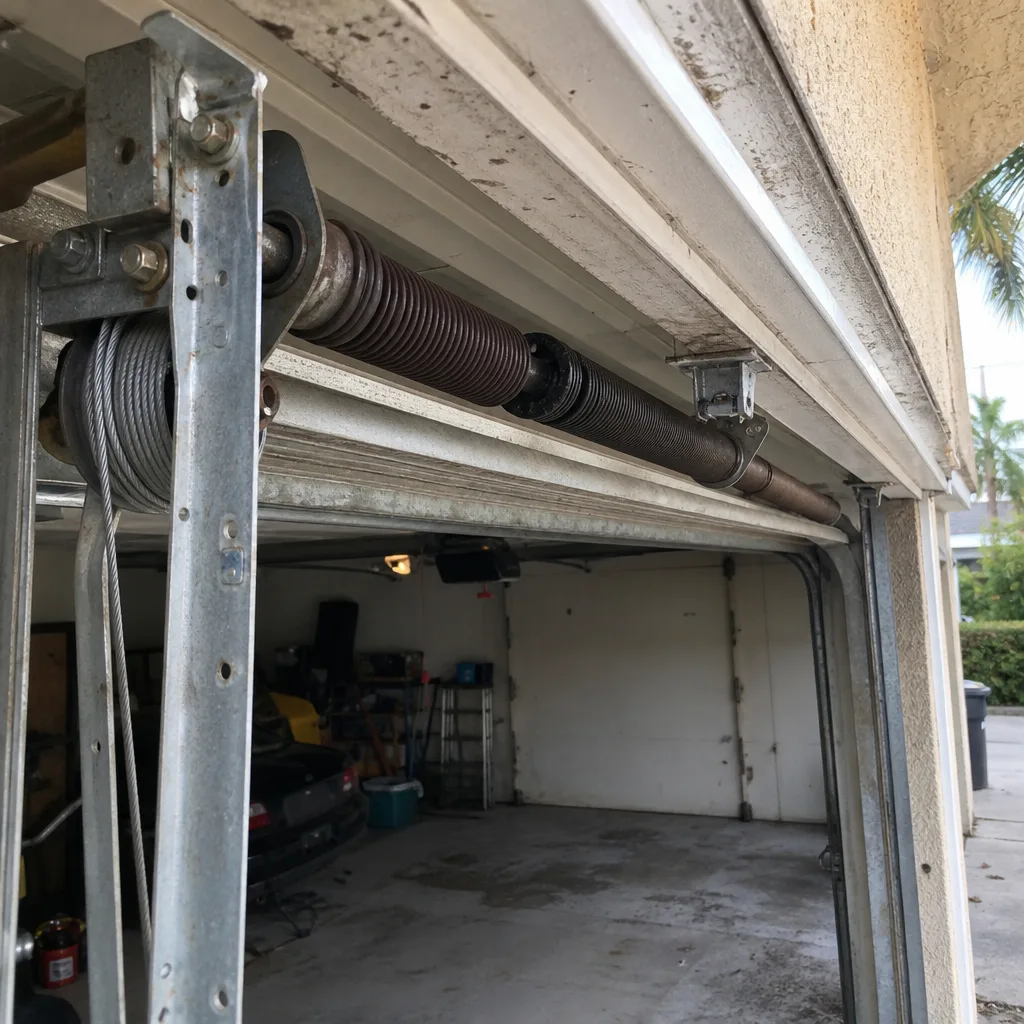
Torsion springs are rated for a specific number of cycles: 10,000, 15,000, or 20,000 depending on the spring quality. One cycle is one open and one close. A typical homeowner opens and closes the garage door three to four times per day, which puts a standard 10,000-cycle spring at the end of its life in seven to nine years. In Hollywood, where most homes have attached garages and daily vehicle use, the average spring lifespan matches that number. The warning sign before a break is a visible gap in the spring coil: when the spring is under tension, a healthy spring has coils that touch each other. A spring with a gap between coils has begun to fatigue, and the gap will widen as the failure approaches. The second warning sign is a door that feels heavier when you lift it manually at the halfway point. Both signs indicate the spring is no longer carrying its rated load.
Lift cables are the paired steel cables that do the actual lifting of the door, winding onto drums at each end of the torsion shaft. The warning sign is fraying: individual strands of the cable will separate and curl away from the main cable body. You can see this by looking along the cable where it meets the drum when the door is closed. Frayed strands mean the cable has already lost some of its load capacity. It will fail completely soon after the fraying is visible. A snapped cable releases the tension on one side of the door, and the door will slam down or jam in the tracks, depending on where in the travel the break happens.
Both of these components are dangerous to work on, and the warning is worth repeating: a torsion spring under tension stores enough energy to seriously injure a person who tries to remove it without the proper winding bars and training. If you see a gap in the spring coil or fraying on a cable, call a professional. Do not attempt the repair yourself.
Opener Behavior: Reversing, Short-Cycling, and Logic Board Fatigue
The opener is the most visible component of the system, but its behavioral symptoms are often the least understood. Three specific behaviors are worth naming.
Reversing before the floor. Every opener manufactured since 1993 has a photo-eye sensor system: two small units mounted on either side of the door opening, about six inches off the floor, that project an invisible beam. If the beam is interrupted, the opener refuses to close, or reverses if it is already closing. When a door reverses about six inches from the floor for no apparent reason, the photo eyes are misaligned, dirty, or have a wiring fault. The fix is usually simple: clean the lenses, check that the beams are aligned by watching for the small indicator light on each unit, and clear any objects from the beam path. Hollywood garages often have stored items that shift and block the beam.
Short-cycling. This is when the opener starts, moves the door a few inches, and stops. In our experience in Hollywood, the most common cause is a force-limit setting that has been turned down too low, often by a previous technician or a well-meaning homeowner following an online guide. The opener thinks it is hitting an obstruction and gives up. The second common cause is a failing logic board, which is the circuit board inside the opener that controls the motor. Logic boards on Chamberlain and LiftMaster openers made before 2015 are starting to fail at scale now, and the symptoms are intermittent and frustrating: the opener works fine for a week, then short-cycles for a day, then works again. A failing logic board cannot be repaired, only replaced, and the replacement is a board swap, not a full opener replacement.
No response at all. Before assuming the opener is dead, check the outlet. Garage outlets in Hollywood are often on the same circuit as exterior lighting or pool equipment, and a tripped GFCI outlet will kill power to the opener entirely. Reset the outlet and test again. If the opener still does not respond, the issue is likely the wall switch wiring or the opener’s internal fuse. Neither is a homeowner repair.
Common Mistakes to Avoid
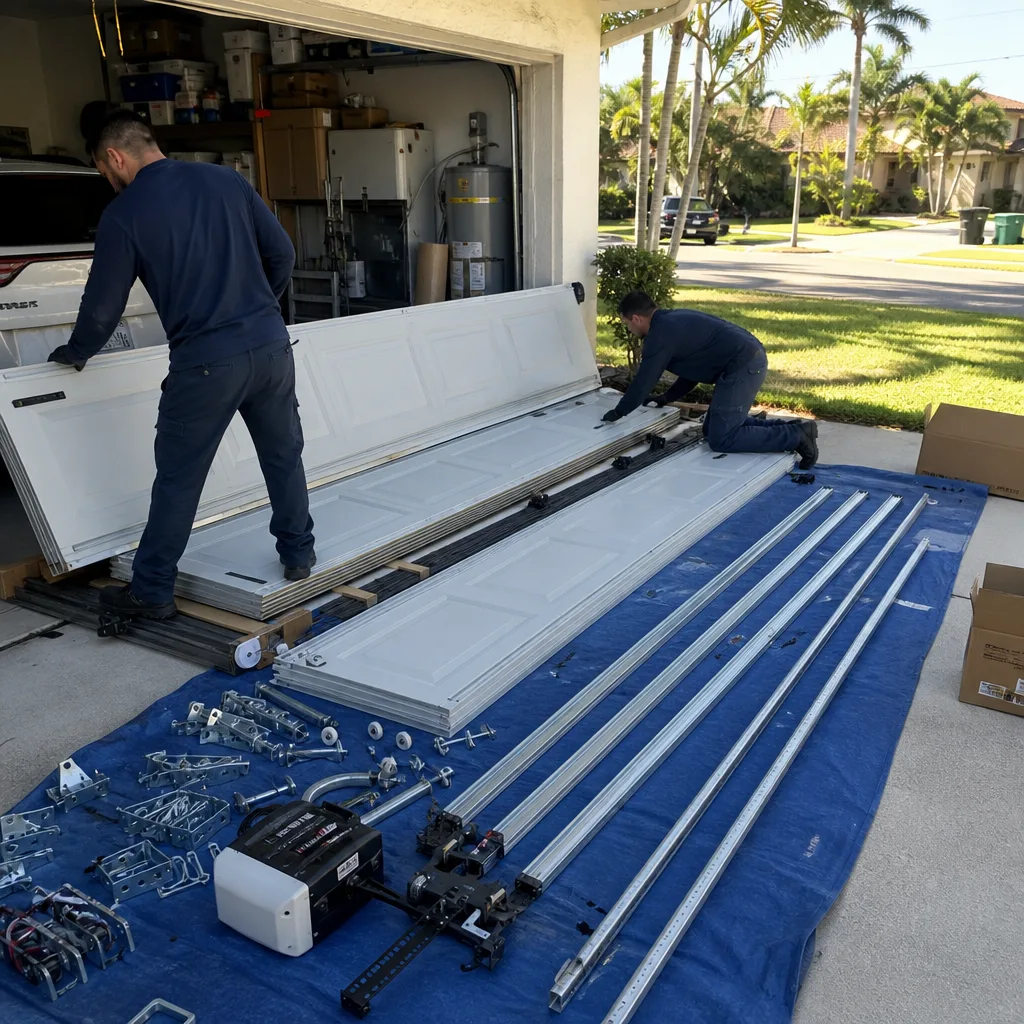
- Lubricating with WD-40. WD-40 is a solvent, not a lubricant. It strips existing grease from hinges and bearings and leaves them drier than before. Use a silicone-based garage door lubricant on rollers, hinges, and springs. Spray lubricant on the torsion spring coils, not the cables.
- Ignoring a slowing door because it still works. The opener motor is absorbing the load that worn rollers or a failing spring should be carrying. Every cycle the door moves slower is a cycle the motor runs hotter. The repair cost rises the longer you wait.
- Painting over rust on the cables or springs. Rust on a torsion spring means the spring coating has failed and the metal is oxidizing. Paint does not restore tension. A rusted spring is a spring near the end of its life.
- Adjusting the opener force settings by feel. The force-limit controls on a LiftMaster or Chamberlain opener are calibrated to the door’s weight and travel resistance. Turning the dial up to “fix” a slow door masks the underlying problem and increases the risk of the opener crushing something in the door’s path.
- Replacing one spring instead of both. Torsion springs are installed in pairs and wear at roughly the same rate. If one spring has broken, the other is not far behind. Replacing only the broken spring means paying for labor twice.
- Blocking the photo-eye beam with stored items. The beam needs a clear line of sight across the full width of the door opening. A box or ladder placed near the door in a Hollywood garage can sit just high enough to interrupt the beam, and the door will refuse to close.
- Texting a photo of the problem to a company that has never seen your door. A photo of a broken spring tells a technician the spring is broken. It does not tell them the door’s weight, the track condition, the opener’s force settings, or the drum configuration. A quote based on a photo is a guess. A written quote based on an in-person inspection is a contract.
When to Call a Professional
Call a professional when the warning sign involves a component under tension: torsion springs, lift cables, or the bottom brackets that anchor the cables to the door. These parts store enough energy to cause serious injury, and the failure mode is sudden. Call a professional when the door is visibly out of alignment and binding, because operating it repeatedly will damage the tracks and panels. Call a professional when the opener is short-cycling or reversing, because the logic board or force settings are rarely the homeowner’s problem to solve. Garage Door Repair in Hollywood from Servo is quoted with a flat, written price and written scope before any work starts, and every visit closes with a documented photo record of the findings. For a free estimate in Hollywood, call (754) 465-7645.
Frequently Asked Questions
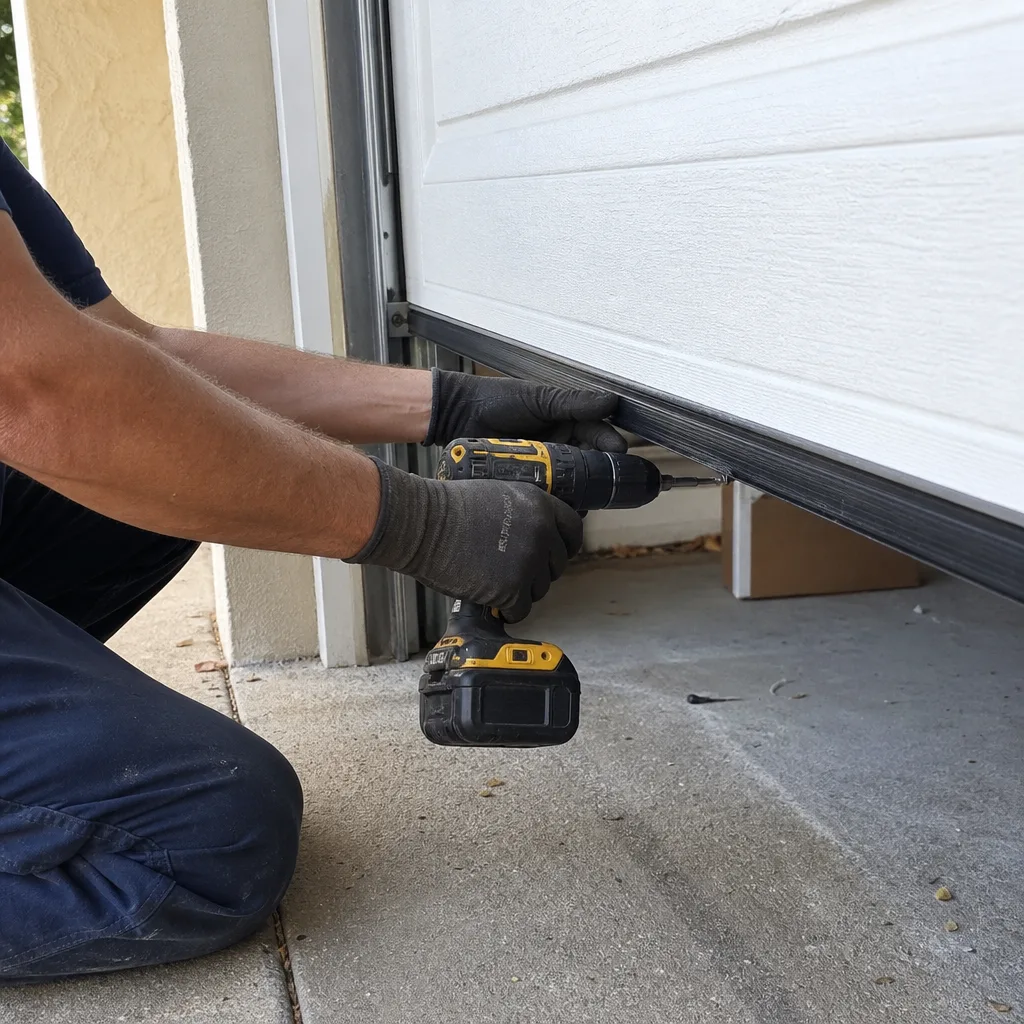
A torsion spring that is failing will show a visible gap between the coils when the door is closed, and the door will feel heavier when you lift it manually at the halfway point. You may also notice the door drifting down when it is left in the half-open position with the opener disconnected. If you see any of these signs, have the spring measured by a technician before it breaks. Call (754) 465-7645 for a free estimate in Hollywood.
A grinding noise is metal on metal, and the most common cause is a roller with seized or worn bearings dragging against the track. The second cause is a loose drive chain dragging against the opener rail. Both are repairable. If the grinding is left alone, the roller will wear a groove into the track and the repair cost increases. Servo technicians photograph the failed component before quoting a replacement, per Clause 4 of The Haven Standard.
A garage door will not free-fall when a spring breaks, because the lift cables still support the door’s weight. However, the door will be severely unbalanced, and if a cable also snaps, the door can drop suddenly. The danger is real, which is why spring and cable work should always be done by a trained professional. If you hear a loud bang from your garage in Hollywood and the door no longer opens normally, stop operating it and call (754) 465-7645.
Lubricate the rollers, hinges, and torsion spring every six months in Hollywood’s climate. The salt air and humidity accelerate oxidation on metal parts, and a six-month schedule keeps the moving components from binding. Use a silicone-based garage door lubricant. Avoid WD-40, which strips existing grease and leaves the parts drier.
It usually means the photo-eye sensor beam is blocked or misaligned. Check that the lenses are clean, the units are pointed at each other, and no stored items are in the beam path. If the door still reverses after cleaning and aligning the sensors, the force-limit setting may be too low, or the logic board may be failing. Garage Door Opener Repair & Installation in Hollywood covers all of these.
Garage door repair in Hollywood typically costs $180 to $340 for common repairs like roller replacement, hinge replacement, or cable re-seating, and $350 to $650 for a full torsion spring replacement. Every Servo job is quoted with a flat, written price and written scope before any work starts, per Clause 1 of The Haven Standard. No surprises on the invoice. Call (754) 465-7645 for an exact quote.
The Bottom Line
Garage door warning signs are specific, nameable, and diagnosable. A grinding sound is a roller. A popping sound is a cable. A banging sound is a spring. A door that moves slower than spec is a door with added friction, not an old door. A crooked door tells you which cable or hinge is failing, and a vibrating opener tells you the mount bolts or drive tension need attention. In Hollywood’s humidity, the season changes the symptom, and the symptom changes the diagnosis. Learn the vocabulary, watch the door, and call a technician who will show you the failed part before quoting the repair. Explore more guides & resources to keep your door running right. That is how Servo has worked since 2015, under The Haven Standard, for 18,000+ garage doors made right. Call (754) 465-7645 for a free estimate in Hollywood.
Written by Marcus Deller, Owner at Servo Garage Doors Hollywood home, serving Hollywood since 2015.