
Last updated September 20, 2026
Full 25-point door and opener safety check with every visit - springs, cables, rollers, tracks, and your LiftMaster or Chamberlain opener included
You get a price before we start. It does not change when the truck arrives.
 Before
 After
After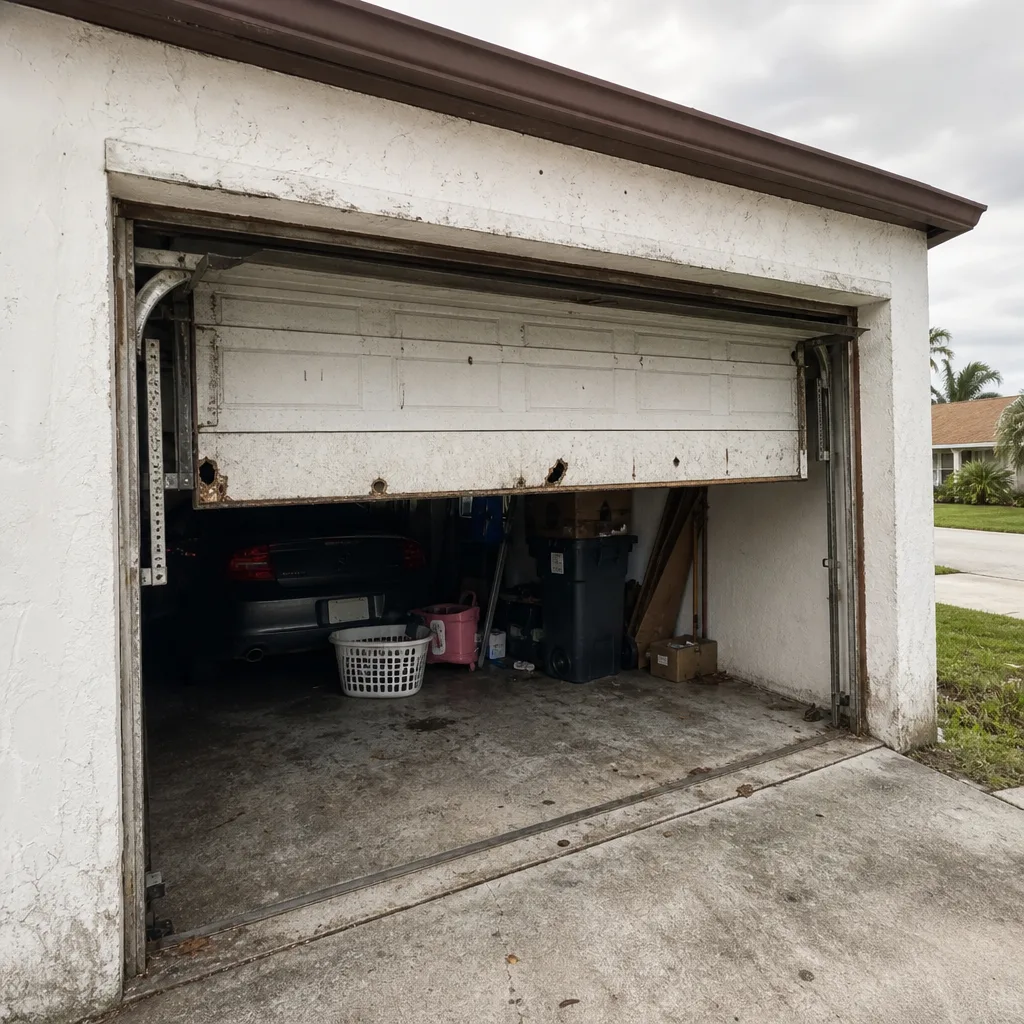 Before
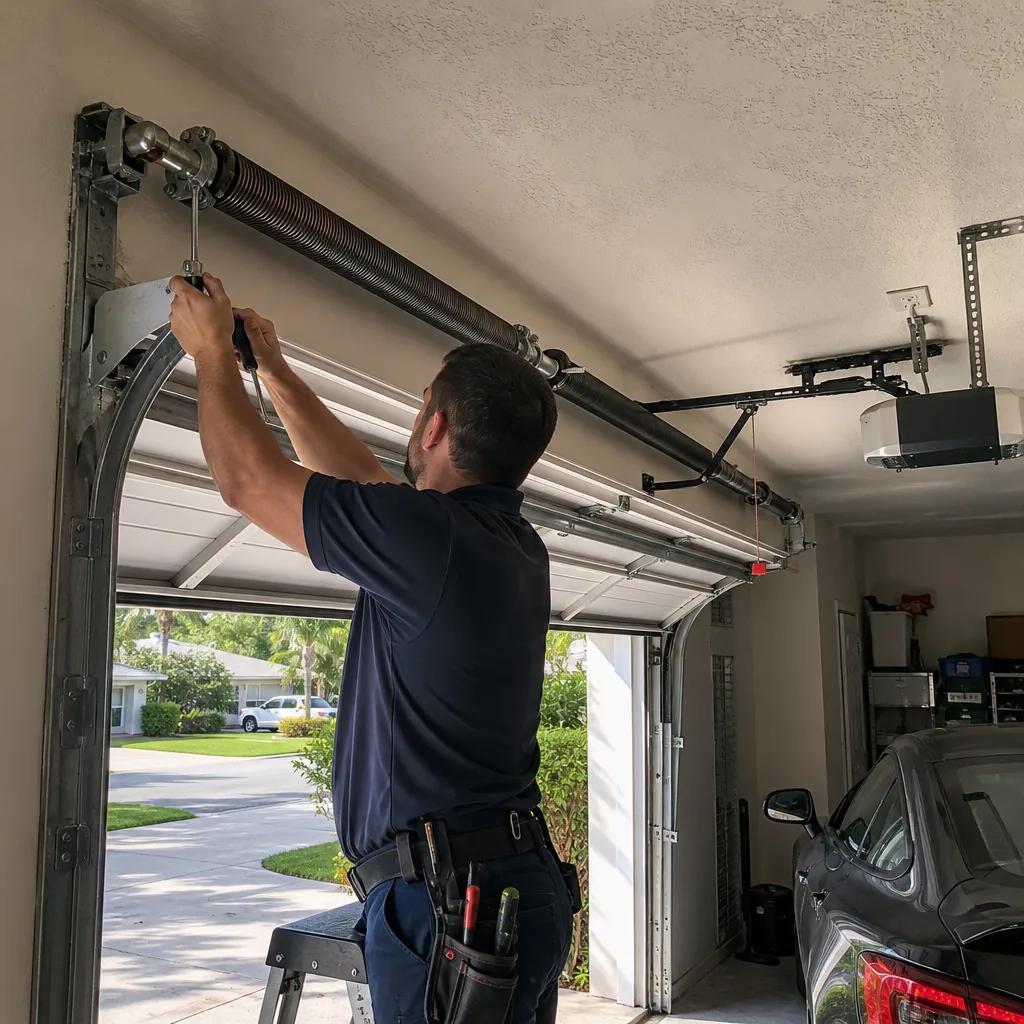 After
After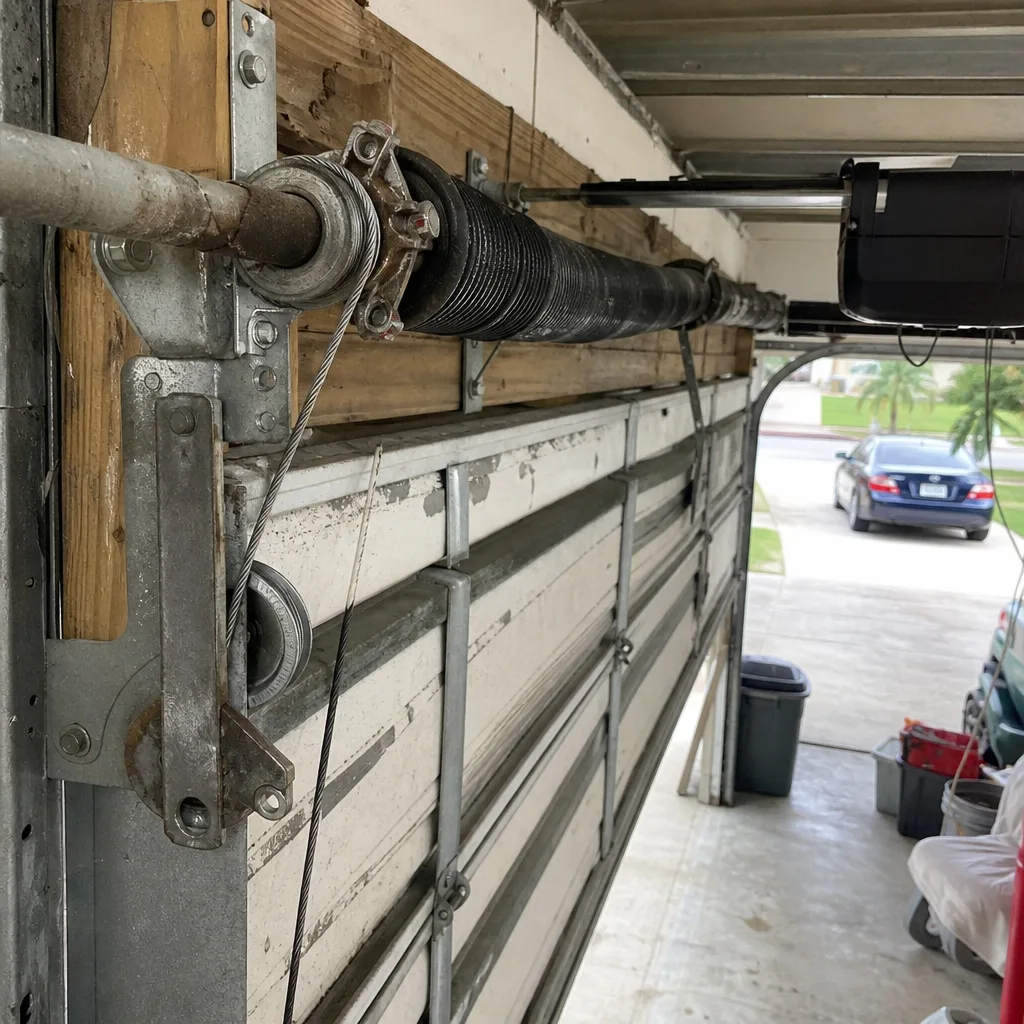 Before
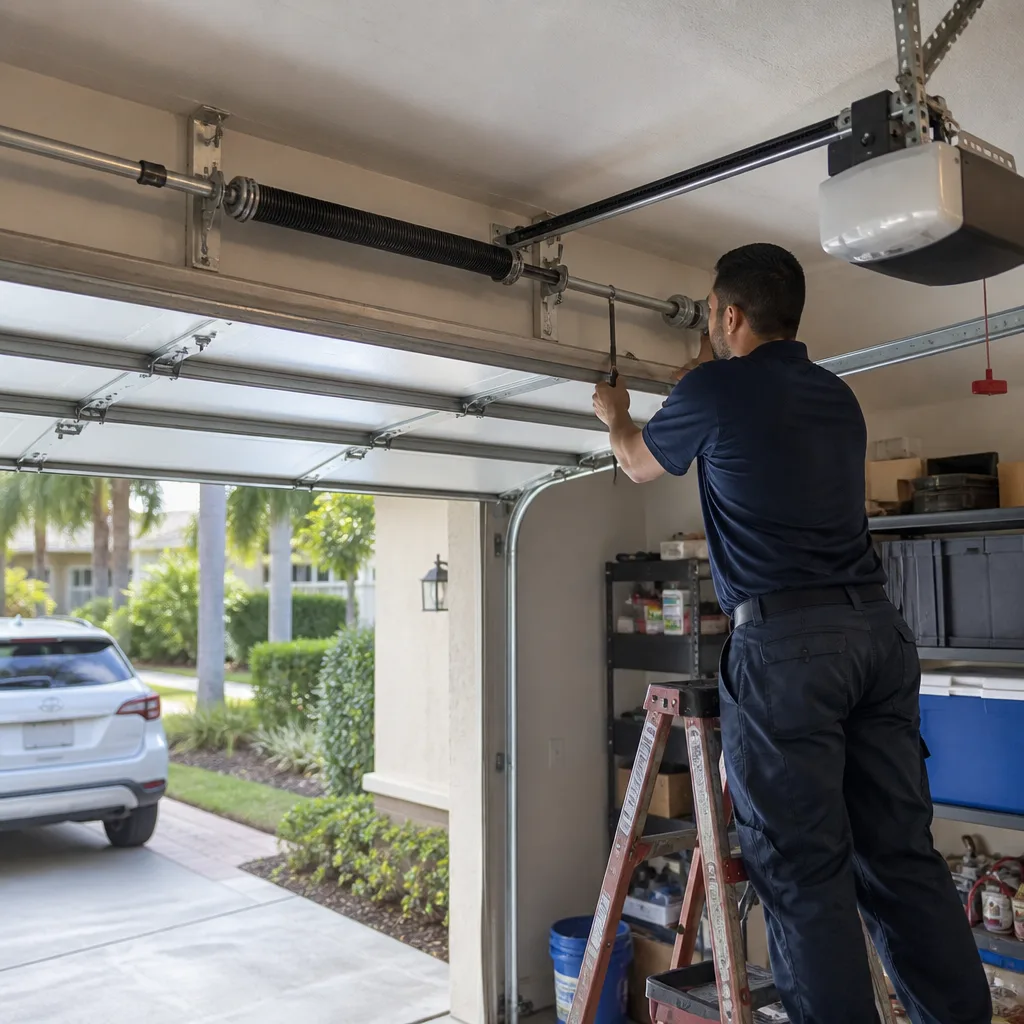 After
AfterThe Complete Guide to Garage Door in Hollywood
A steel garage door rated for 50,000 cycles can corrode through its bottom panel in under 18 months when installed within a mile of the Intracoastal. That fact appears in zero manufacturer brochures, but it shows up in every Hollywood technician’s van, usually as a rusted bottom stile and a homeowner holding a quote for a door that should have lasted two decades. This guide maps every garage door decision against the three conditions that define Hollywood, FL: salt air, hurricane code, and HOA aesthetic rules. By the end, you’ll know which materials, insulation values, openers, and hardware actually survive here, and which ones you should never pay for.
Quick Answer
Choosing a garage door in Hollywood, FL means matching your material to your distance from salt water, your wind-load rating to Florida Building Code Section 1609, and your style to your HOA’s approval process. For most Hollywood homes more than half a mile from the Intracoastal, a galvanized steel door with an R-value between 12 and 16, paired with a belt-drive opener and corrosion-resistant hardware, delivers the best balance of cost, hurricane performance, and longevity. Homes within half a mile of salt water should seriously consider aluminum or fiberglass doors with marine-grade hardware instead.
Table of Contents
- Salt Air and Material Selection: What Actually Lasts in Hollywood
- Florida Building Code Wind-Load Requirements: The Hardware Spec Nobody Explains
- HOA Approval Cycles in Hollywood’s Gated Communities
- R-Value Math in a Cooling-Dominated Climate
- The Four Components Behind 80% of Hollywood Service Calls
- Garage Door Opener Selection for Hollywood Homes
- What Installation Looks Like When It’s Done Right
- Common Mistakes to Avoid
- When to Call a Professional
- Frequently Asked Questions
- The Bottom Line
BeforeAfterSalt Air and Material Selection: What Actually Lasts in Hollywood
Hollywood sits on a barrier between the Atlantic and the Intracoastal Waterway, which means the air itself carries salt. Not uniformly, though. The corrosion gradient is real and measurable. Homes east of US-1 and along the Intracoastal see significantly higher chloride deposition than homes west of I-95. That matters because it rewrites the standard material advice you’ll find in generic garage door guides.
Steel doors are the most common choice nationwide, and they work fine in Hollywood when two conditions are met. First, the steel must be galvanized, meaning it went through a zinc-coating process at the mill. Second, the door should be located at least half a mile from the Intracoastal or the ocean. Galvanized steel resists rust well under normal conditions, but constant salt spray accelerates zinc depletion. When the zinc goes, the steel follows.
For homes closer to salt water, the choices narrow to two materials that don’t corrode the same way:
- Aluminum doors: Aluminum doesn’t rust, though it can pit over time. Modern aluminum garage doors come with powder-coated finishes that hold up well against salt exposure. They’re lighter than steel, which means less strain on springs and cables over the life of the door. The trade-off is dent resistance. Aluminum dents more easily than steel, which matters if your driveway doubles as a basketball court or your teenagers park by feel.
- Fiberglass doors: Fiberglass is inert. Salt doesn’t touch it. It doesn’t dent like aluminum, either, and it can be finished to mimic wood grain, which appeals to HOAs with architectural review boards. The weakness is long-term UV exposure. Florida sun is brutal on the gel coat finish, and faded fiberglass looks tired faster than faded steel. If you go fiberglass, budget for occasional refinishing.
We’ve replaced steel doors in Hollywood’s Lakes neighborhood that failed within three years because the original builder installed non-galvanized panels. We’ve also seen galvanized doors in the same neighborhood hit year twelve with nothing more than a bottom seal swap. The difference was never the brand. It was the galvanization and the distance from salt.
One more material note: wood doors are beautiful and almost never the right choice within two miles of the Intracoastal. Wood absorbs moisture, swells, and invites rot. In Hollywood’s humidity, a wood door is a maintenance contract with your future self. If you want the wood look, a steel door with a wood-grain embossed finish or a fiberglass door with a faux-wood texture gets you 90% of the aesthetic with none of the rot risk. See our garage door installation guide for Hollywood for more on material comparisons.
Florida Building Code Wind-Load Requirements: The Hardware Spec Nobody Explains
Every garage door sold and installed in Hollywood must meet Florida Building Code Section 1609 wind-load requirements. What most guides won’t tell you is that the wind-load rating changes the hardware specification, not just the door panel. The door is only as strong as the track, the hinges, the rollers, and the reinforcement struts that hold it to the frame.
Broward County sits in a High Velocity Hurricane Zone. That means garage doors here need a design pressure rating, expressed as a positive and negative number in pounds per square foot (psf). For most single and two-car doors in Hollywood, the required rating falls between +35/-35 psf and +50/-50 psf, depending on your exact location, the door’s size, and your home’s exposure category. Homes closer to the coast fall into higher exposure categories, which pushes the required rating up.
What changes when a door is wind-load rated:
- Reinforcement struts: Galvanized steel struts are bolted across the interior of each section. These are the main defense against wind pressure bowing the door inward. A door without adequate strutting will flex and eventually tear off its hinges in a storm.
- Hinges and brackets: Wind-rated doors use heavier gauge steel hinges with more attachment points per section. The difference between a standard hinge and a wind-rated hinge is roughly double the metal thickness.
- Track and jamb brackets: The vertical and horizontal tracks must be anchored to the wall and ceiling with brackets spaced more tightly than a non-rated installation. If the track pulls off the wall, the door becomes a sail.
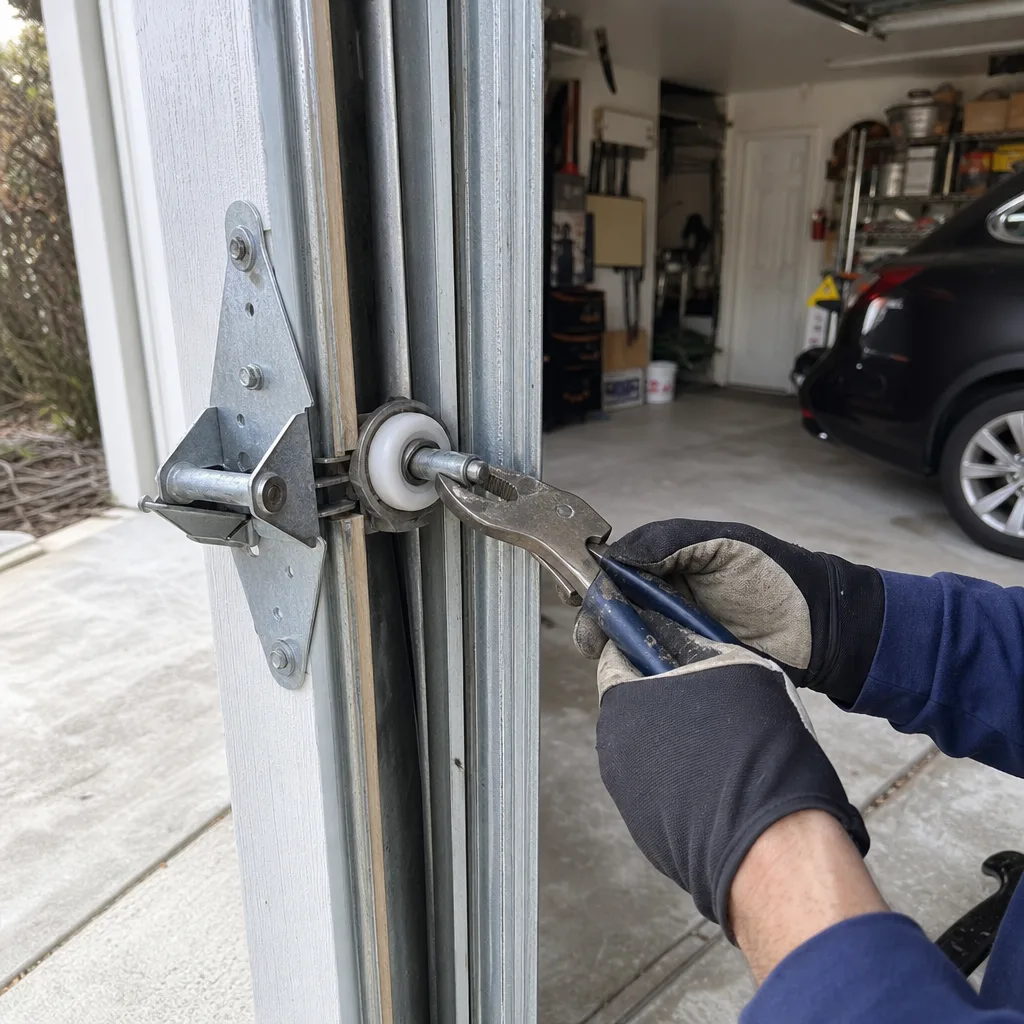
- Rollers: Wind-rated doors usually require rollers with longer stems and heavier bearings, because the door is moving under load even when it’s closed. A standard roller can pop out of the track when the door flexes.
The cost difference between a non-rated door and a properly wind-rated door in Hollywood is typically $200 to $500, depending on door size. That’s the cheapest insurance you’ll ever buy. When you’re comparing quotes, ask for the design pressure rating in writing. If the company can’t produce it, they’re not selling you a code-compliant door for Broward County. Our Hollywood garage door repair technicians see post-storm damage every season that traces back to under-specified hardware, not failed panels.
How to Verify a Wind-Load Rating
You don’t need to become an engineer to check this. Here’s what to ask, in plain terms:
- Ask for the door’s NOA number (Notice of Acceptance). Every wind-rated door sold in Florida has one, issued by Miami-Dade County or the Florida Building Commission.
- Confirm the NOA covers your exact door size and model. A rating for an 8×7 door doesn’t transfer to a 16×7.
- Ask whether the installation includes a written wind-load certification. Some HOAs and insurance carriers require it after installation.
If a contractor reacts to these questions with vague reassurances, that’s information. A door that doesn’t meet code won’t just fail in a storm. It may also void your homeowners insurance claim if the insurer determines the door was under-specified.
HOA Approval Cycles in Hollywood’s Gated Communities
Hollywood has a higher concentration of gated and deed-restricted communities than most South Florida cities. Emerald Hills, the Lakes, Hollywood Lakes, Harbor Islands, and a dozen smaller enclaves each run their own architectural review committees. If you live in one of these communities, your garage door purchase has an extra step that no manufacturer guide covers: you need permission before you buy.
The approval process typically works like this:
- You submit a door style, material, color, and sometimes a manufacturer spec sheet to the HOA’s architectural review committee.
- The committee reviews your submission against its design guidelines, which may specify approved colors, materials, window configurations, and even specific manufacturers.
- Approval or denial usually arrives within 14 to 45 days, depending on how often the committee meets. Some Hollywood HOAs review monthly, which means a denial resets your timeline by thirty days.
- Once approved, you have a window (often 90 days) to complete the installation. If you exceed it, the approval lapses and you start over.
The styles that clear Hollywood HOA review fastest are remarkably consistent across communities:
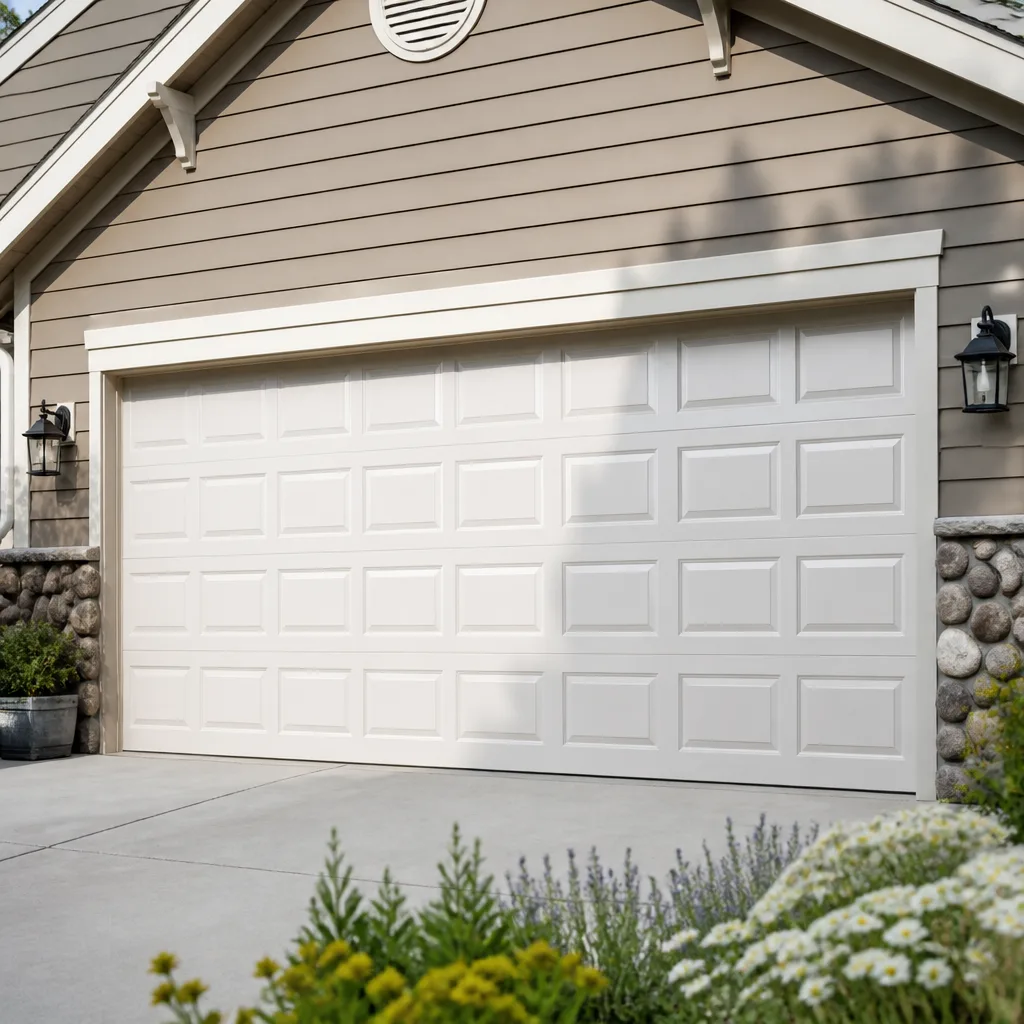
- White or off-white steel doors with raised panels: The default choice in communities built between 1990 and 2015. It matches existing doors and rarely draws objection.
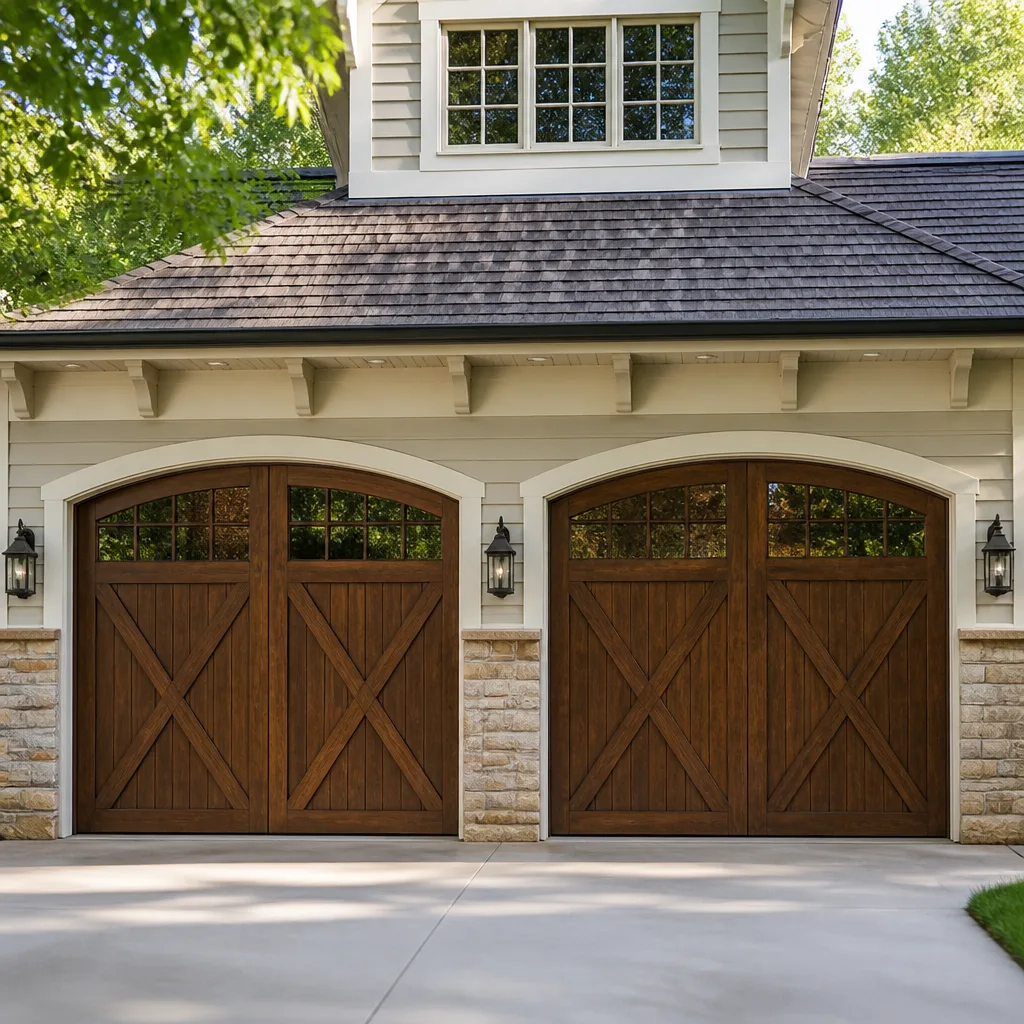
- Wood-grain embossed steel in medium browns: Acceptable in most communities that allow non-white doors, provided the finish is consistent across sections.
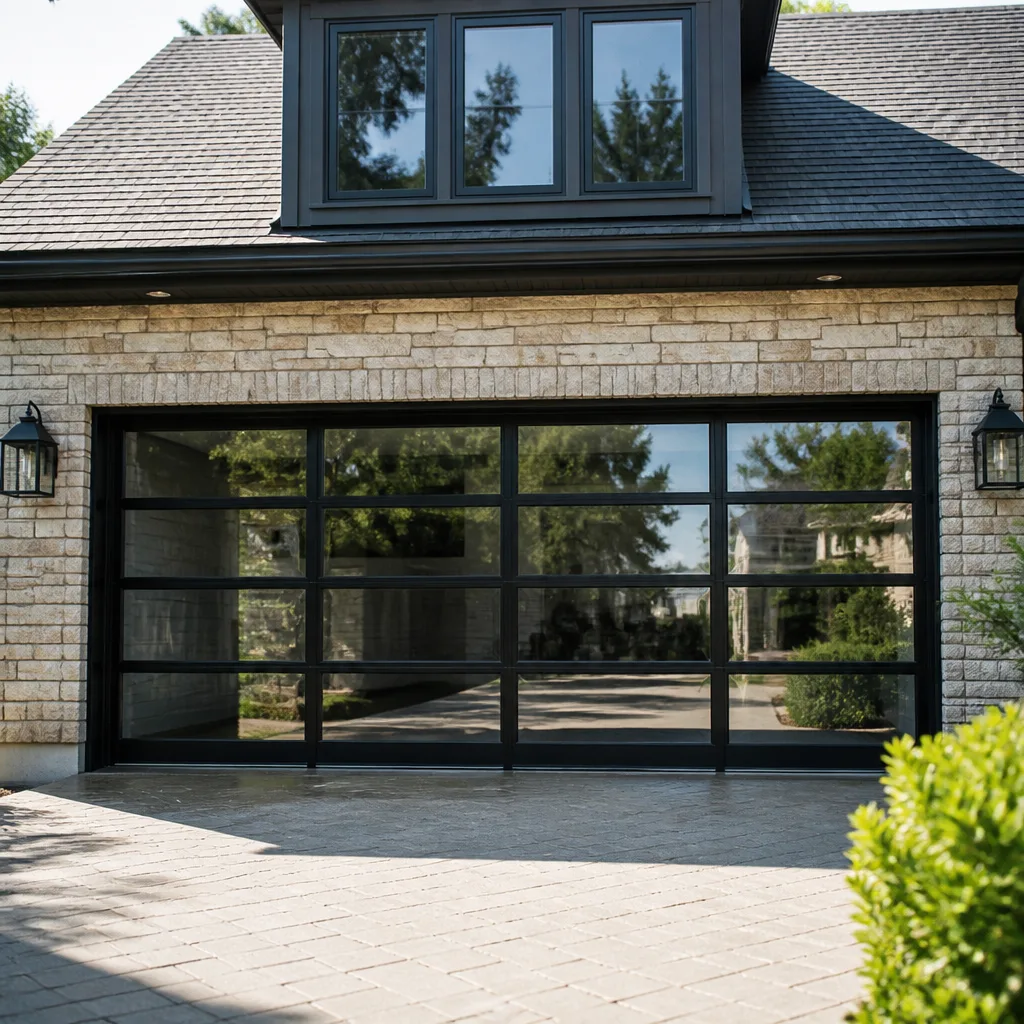
- Aluminum full-view doors with frosted glass: Popular in Harbor Islands and other modern communities, where contemporary architecture is part of the design language.
The styles that get denied or delayed most often are custom wood doors (maintenance concerns), bright primary colors, and doors with unpainted aluminum frames in communities where painted steel is the norm. Before you fall in love with a door, pull your HOA’s design guidelines and read the garage door section. If you’re quoted a door that violates the guidelines, you’ll either fight the committee or eat the cost of a replacement.
We advise Hollywood homeowners to start the HOA conversation before scheduling a measure, not after. A good installer will provide the spec sheet and color samples your committee needs for the submission. Our garage door opener repair and installation team coordinates with HOAs regularly and knows what the major Hollywood communities require.
R-Value Math in a Cooling-Dominated Climate
Most garage door insulation guides are written for northern climates where the garage is cold and the house holds the heat. In Hollywood, the equation inverts. Your garage door faces the sun for most of the day, and a non-insulated steel door can turn a garage into a convection oven. We’ve measured garage temperatures above 120°F in August in Hollywood’s Driftwood and Park East neighborhoods. That heat doesn’t stay in the garage. It radiates into any room above or adjacent to it, and it forces your air conditioning to work harder.
R-value is the measure of thermal resistance. A higher number means better insulation. Here’s what the numbers map to in Hollywood’s climate:
- R-0 to R-6 (non-insulated or minimally insulated): Fine for detached garages with no living space adjacent. The door will be hot, but if nothing behind it cares, neither should you. Many Hollywood homes built before 1990 have this setup.
- R-6 to R-12: The practical floor for attached garages. Insulated enough to reduce heat transfer into the house without overspending. A polystyrene-insulated steel door typically lands here.
- R-12 to R-18: The sweet spot for Hollywood homes with a bedroom, office, or finished space above the garage. Polyurethane-injected doors hit this range and also gain structural rigidity, which helps with wind-load performance.
- R-18+: Typically overkill in Hollywood unless you’ve converted the garage into living space with its own climate control. The extra cost doesn’t pay back in cooling savings in this climate.
One Hollywood-specific wrinkle: insulation type matters as much as R-value. Polystyrene (the foam board look) is cheaper, but it’s cut to fit and leaves gaps. Polyurethane is injected and expands to fill the entire cavity, which reduces air infiltration and adds stiffness. Given the wind-load requirements in Broward County, polyurethane doors pull double duty: they insulate and they resist deflection better under pressure.
The Four Components Behind 80% of Hollywood Service Calls
When a garage door fails in Hollywood, the breakdown is rarely mysterious. Four components account for the overwhelming majority of service calls we run across the city, from Hollywood Hills to the beachside condos. Understanding these four parts, and what they cost to fix, is the difference between a $200 repair and a $1,500 door replacement.
1. Torsion Springs
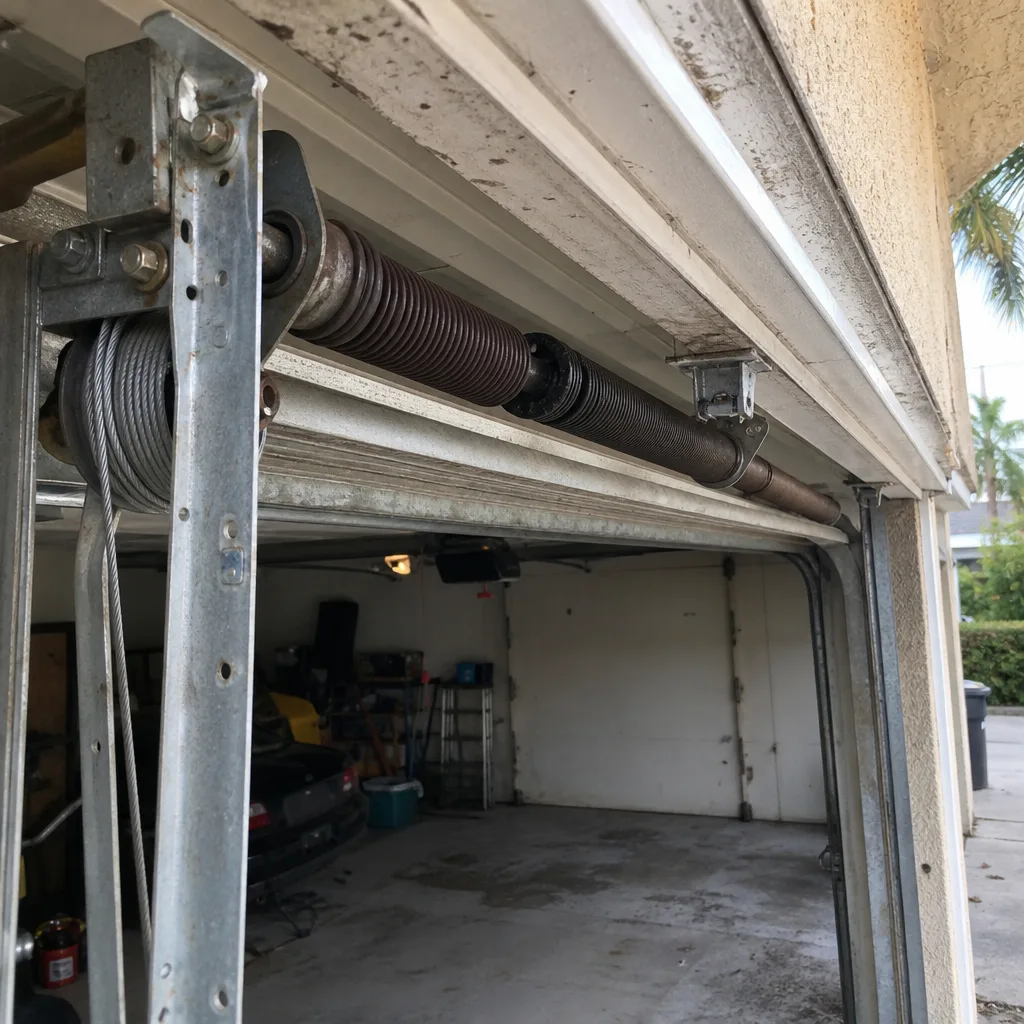
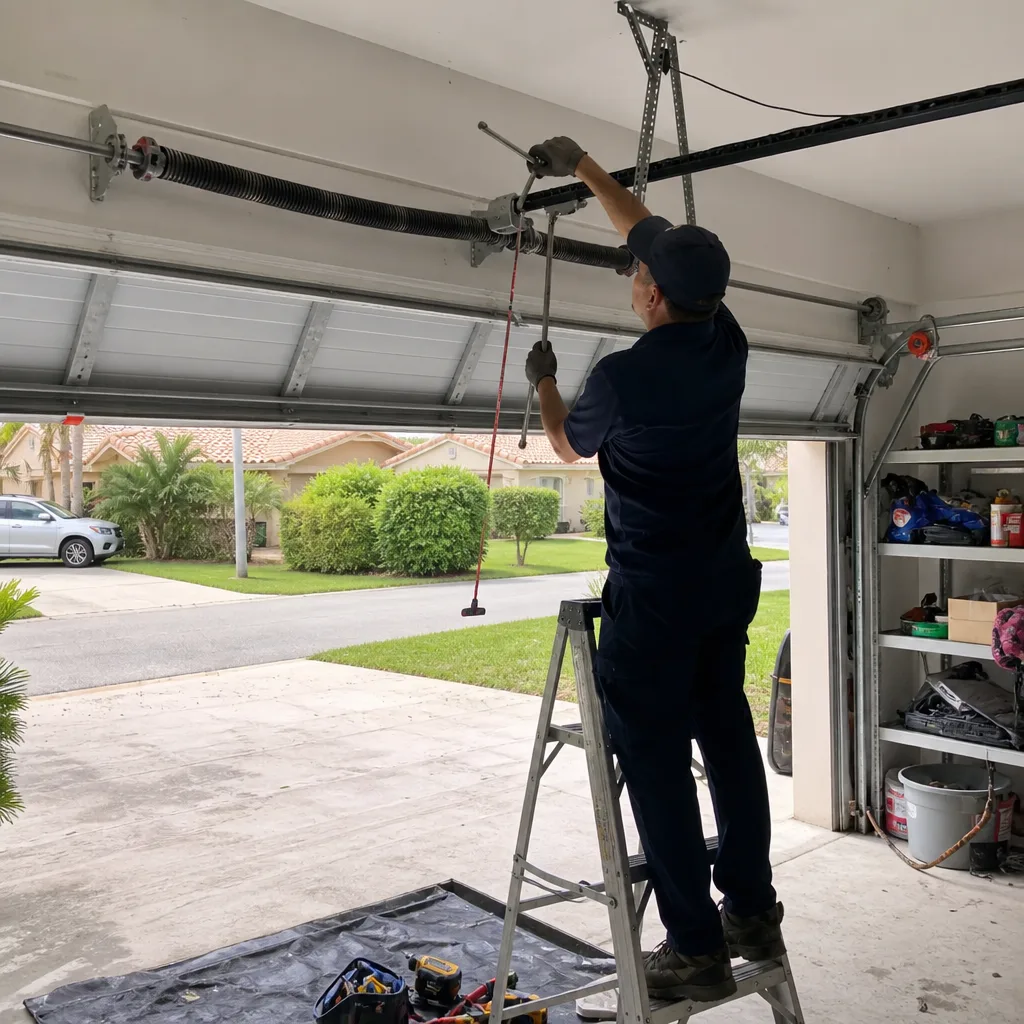
The torsion spring sits above the closed door and stores the mechanical energy that makes a 150-pound door feel like it weighs 20. Every time the door opens and closes, the spring cycles. A standard spring is rated for 10,000 cycles, which is roughly seven years of normal use in a Hollywood household. When it breaks, the door won’t open, and if the opener strains against the broken spring, you can burn out the motor in a week.
Torsion spring replacement in Hollywood runs $180 to $340 per spring, and most doors have one or two, depending on width. High-cycle springs rated for 25,000 to 50,000 cycles cost more upfront, typically $250 to $450 per spring, and make sense if you plan to stay in the home long-term or your household cycles the door heavily. The springs carry lethal tension. This is not a DIY repair. In Hollywood, where salt air already shortens component life, a cheap spring is a false economy.
2. Cables
The lift cables run along both sides of the door and connect the bottom brackets to the spring assembly. When a cable frays or snaps, the door drops unevenly, jams, or in the worst case, falls entirely. Cables fail in two ways in Hollywood: corrosion from salt air weakens them over time, or a worn spring places uneven tension that overloads one side.
Cable replacement is typically $150 to $250, including labor. If a cable has snapped, the springs usually need to be reset or replaced at the same time, which is why a cable repair often turns into a spring job. A good technician photographs the cable and the spring end before quoting, so you can see exactly what failed.
3. Rollers
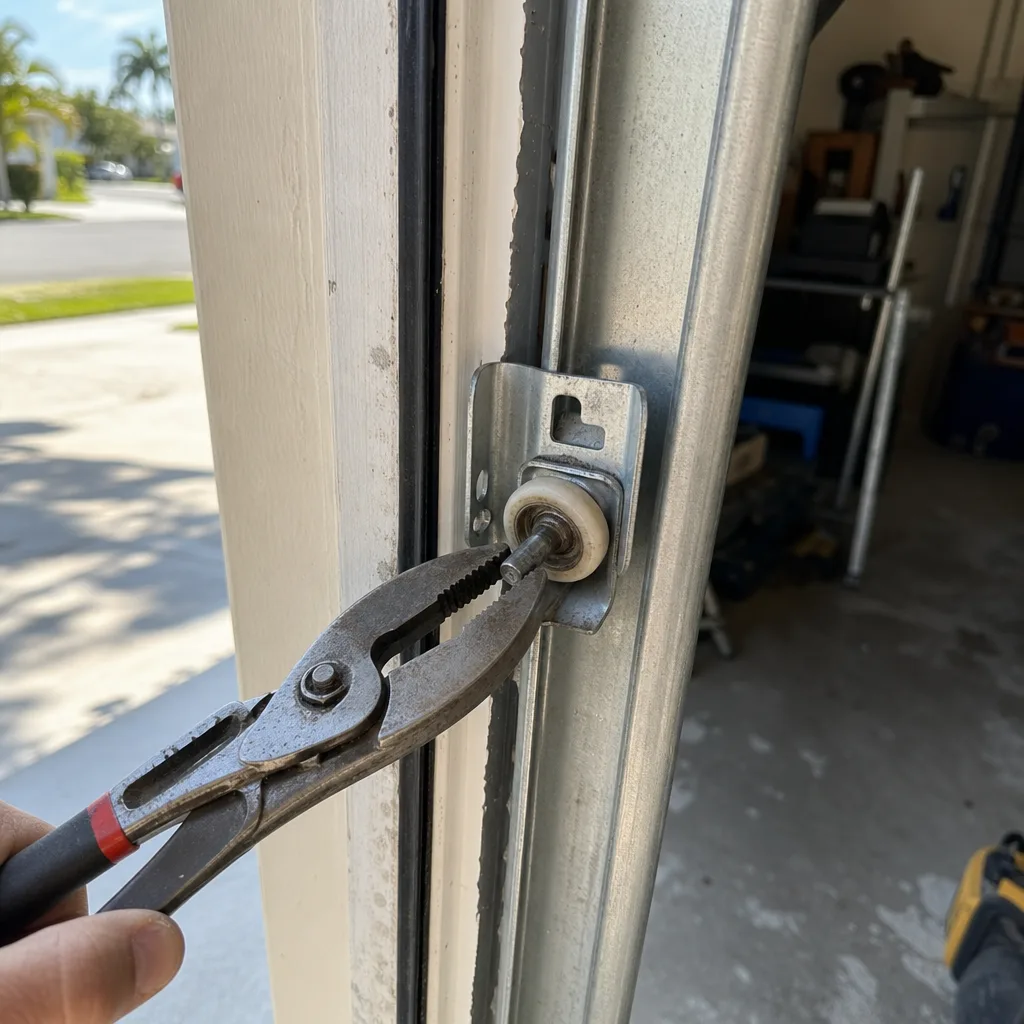
Rollers guide the door up and down the tracks. The cheap ones installed on most builder-grade doors are steel with unsealed ball bearings. Salt air eats them. Within a few years in a coastal Hollywood home, you’ll hear grinding, then squealing, then a wheel that’s seized solid enough to score the track.
Replacing all rollers is $120 to $200. Nylon rollers with sealed bearings last dramatically longer in salt exposure and run quieter than steel. If your door sounds like a shopping cart with a bad wheel, don’t replace the opener. Replace the rollers. It’s the least expensive fix that improves daily quality of life, and it takes a technician about an hour.
4. Bottom Seal
The rubber seal along the bottom edge keeps rain, leaves, and insects out. In Hollywood, it also keeps out the inch of standing water that pools at garage doors during summer downpours. The seal dries out in the heat, cracks, and eventually splits. A failed seal is the leading cause of water intrusion and the rusted bottom panels we mentioned earlier.
A bottom seal replacement runs $80 to $150, parts and labor included. It should be inspected every two years, and in homes within a mile of salt water, annually. If you see daylight under the door when it’s closed, the seal is already gone.
For a complete breakdown of what these repairs cost and when they make sense, see our garage door repair guide for Hollywood homeowners.
Garage Door Opener Selection for Hollywood Homes
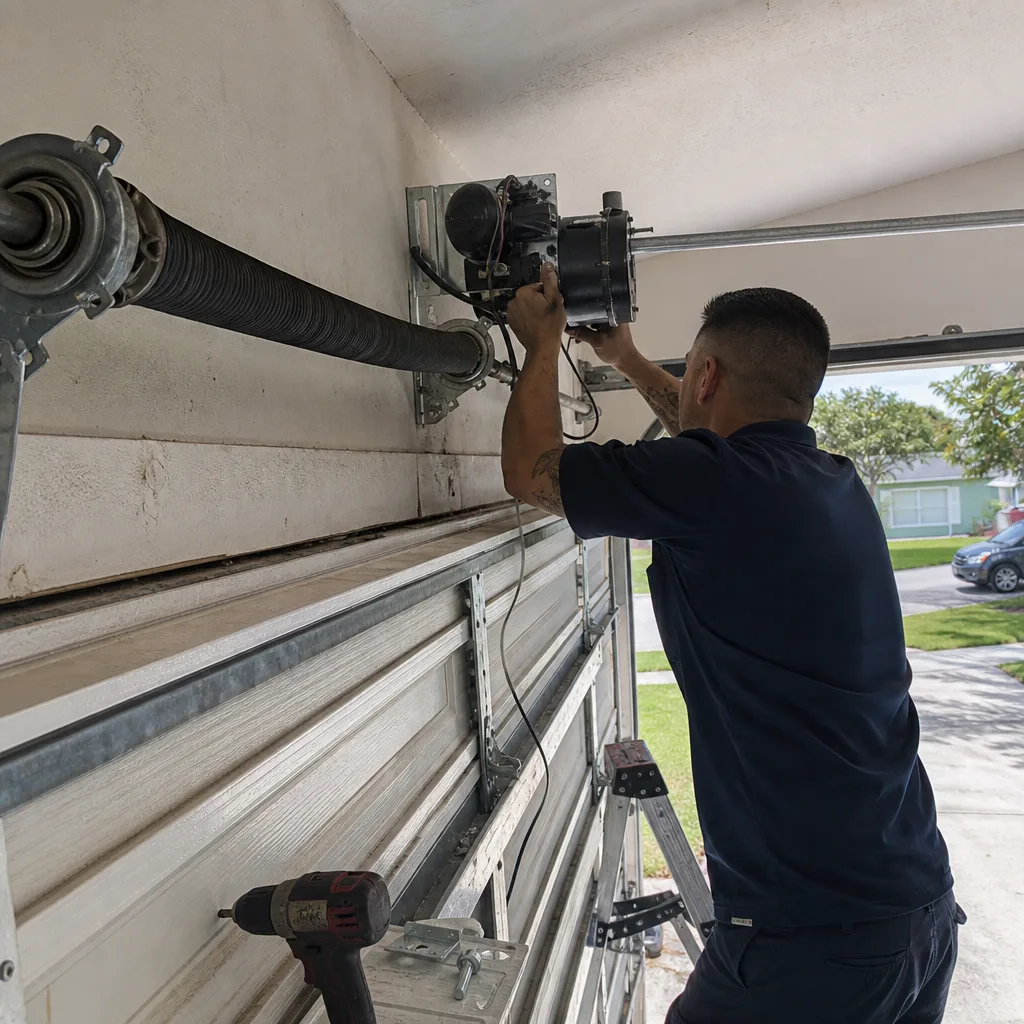
The opener is the most misunderstood component in the whole system. People replace openers because the door is noisy, when the real culprit is the rollers. They buy horsepower because the door struggles to open, when the real culprit is a dying spring. And in Hollywood, they buy the same opener their northern relatives recommend, without accounting for heat, humidity, and the way salt air shortens electronics.
Here’s what actually matters when selecting an opener in Hollywood:
Drive Type: Belt vs. Chain vs. Screw
- Belt drive: A reinforced rubber belt moves the trolley along the rail. Quiet, smooth, and the best choice for attached garages where a bedroom sits above. Belt drives cost more upfront ($280 to $450 for the unit) but last longer and don’t stretch like chains. LiftMaster’s belt-drive models are the most common in Hollywood attached-garage installations.
- Chain drive: A metal chain drives the trolley. Louder, but cheaper ($200 to $320) and perfectly fine for detached garages. The chain needs occasional tensioning, which is a service call most Hollywood homeowners never schedule until the chain drops off the sprocket.
- Screw drive: A threaded steel rod rotates to move the trolley. These used to be popular in humid climates because they’re less affected by moisture than chains, but they’re noisier than belts and maintenance-heavy. We rarely recommend them for Hollywood homes today.
Horsepower: Where Heat and Humidity Matter
A 1/2 HP opener is adequate for a standard aluminum or lightweight steel door. A 3/4 HP or 1 HP unit is worth the extra $50 to $100 if the door is steel with polyurethane insulation, or if it’s a double door. Hollywood’s humidity swells door sections slightly, and heat softens the door’s weatherstripping, both of which add small amounts of resistance. A stronger motor doesn’t work harder; it works less hard for longer.
The Salt Air Factor on Electronics
Openers contain a logic board, the circuit board that controls the motor, safety sensors, and remote receivers. Logic boards fail faster in coastal environments because salt-laden air accelerates corrosion on solder joints and connectors. When a logic board dies, the opener appears completely dead, and the repair is $150 to $250 for the board, or $300 to $450 for a full opener replacement.
The practical takeaway: don’t overspend on an opener with features you won’t use, but don’t buy the cheapest unit either. The mid-range belt-drive models from LiftMaster and Chamberlain are the workhorses of Hollywood garages. Craftsman and Raynor also make solid units, but verify the warranty covers electronics for at least four years, and understand that in coastal Hollywood, the opener is more likely to die from corrosion than from mechanical wear. We stock parts for all major brands on our garage door opener repair and installation trucks, which means most opener repairs here are same-day jobs.
What Installation Looks Like When It’s Done Right
Most garage door guides stop at the sale. But how the door is installed determines whether it lasts eight years or twenty. In Hollywood, where code enforcement and HOA rules are both strict, the installation process has specific steps that separate a proper job from the rest.
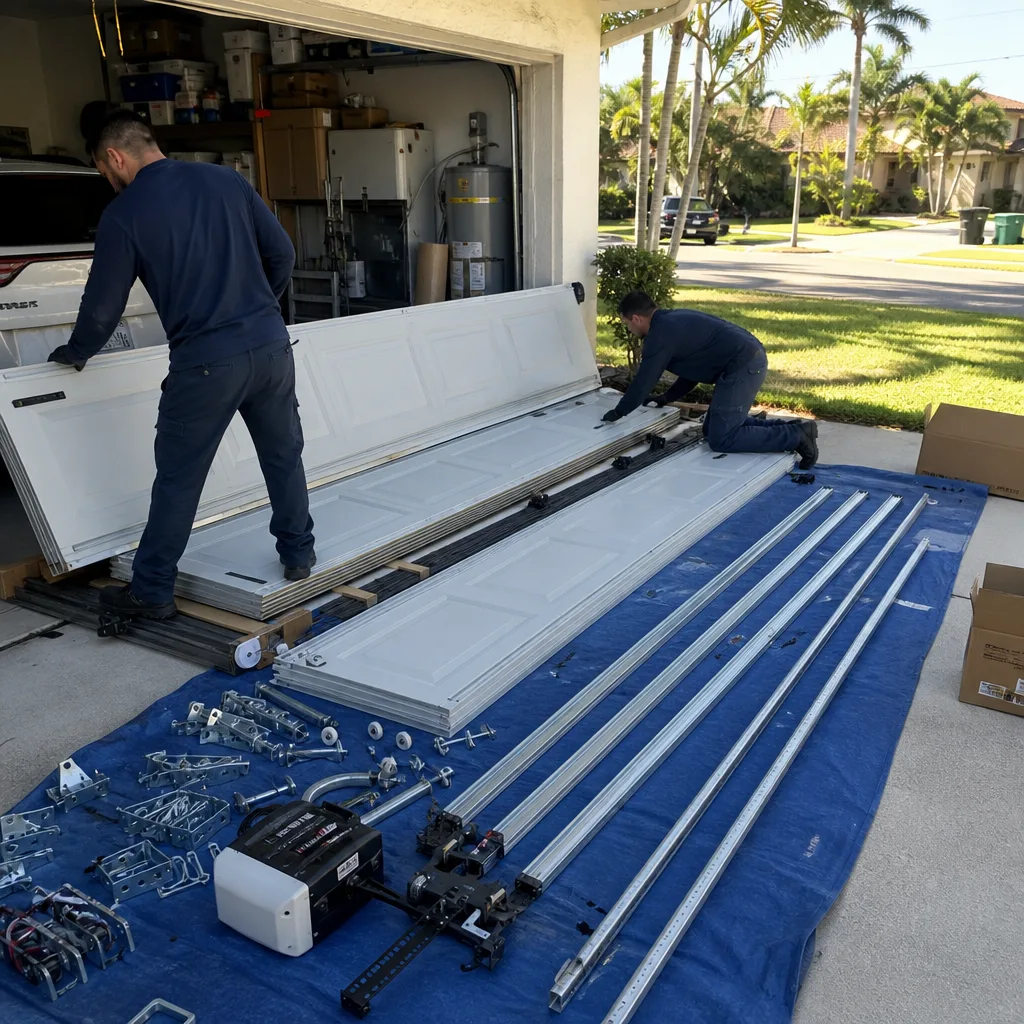
Here’s the sequence that defines a correct installation in Hollywood:
- Written measure and written quote before any commitment: The technician measures the opening, confirms the headroom and sideroom, and documents the exact door size, material, insulation, wind-load rating, and hardware spec. The price is written, flat, and includes everything: door, hardware, tracks, springs, seal, labor, haul-away of the old door. No vague line items. No “to be determined” asterisks.
- HOA documentation: If your community requires approval, the installer provides the spec sheet, color samples, and wind-load documentation needed for submission. In many Hollywood communities, a missing NOA number is an automatic denial.
- Old door removal and inspection: The old door comes down in sections, and the technician photographs what’s underneath: the jamb condition, the header, any signs of termite damage or rot. Hollywood homes built in the 1960s and 1970s often have framing issues that should be addressed before a new door goes up.
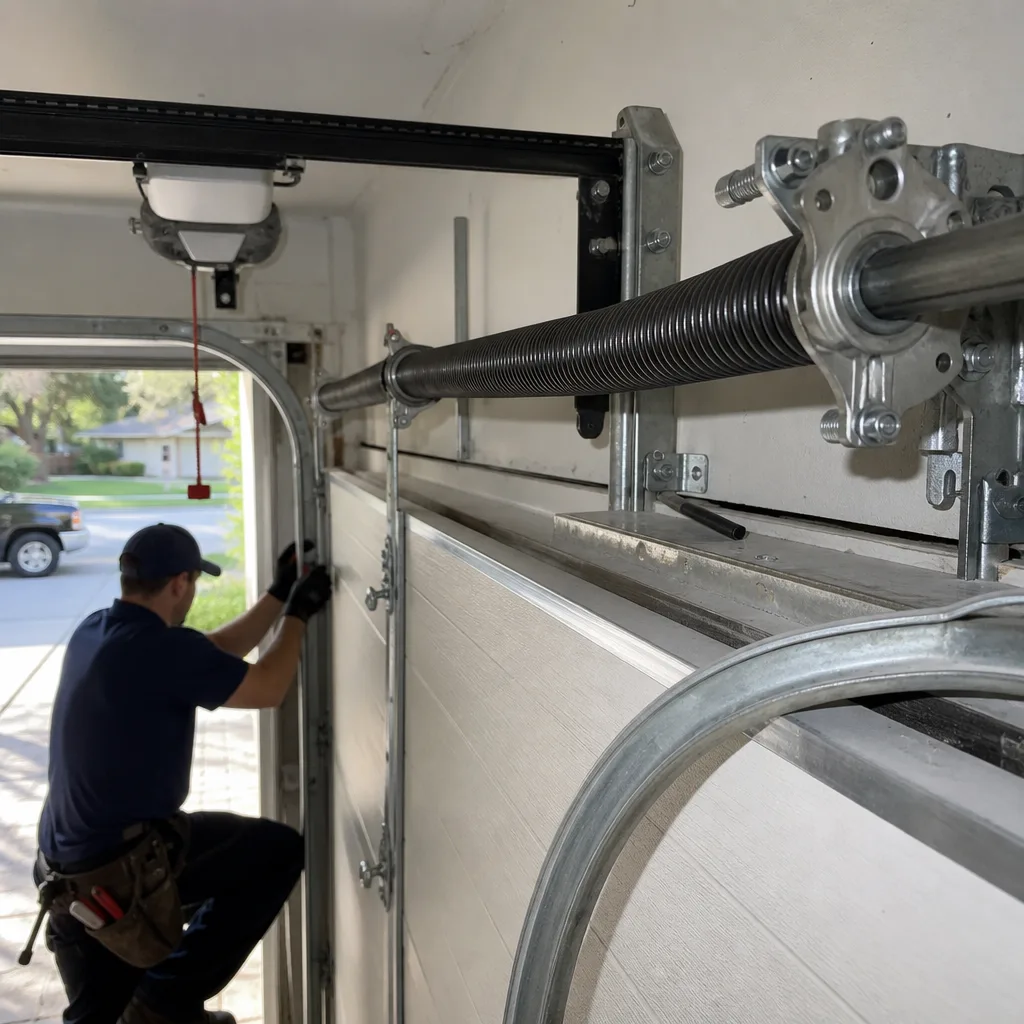
- Hardware and track installation: Wind-rated brackets anchor to the framing at proper spacing. The horizontal tracks are pitched slightly toward the back of the garage, the correct angle for smooth operation. Springs are wound to match the door’s exact weight, not the weight of a “similar” door.
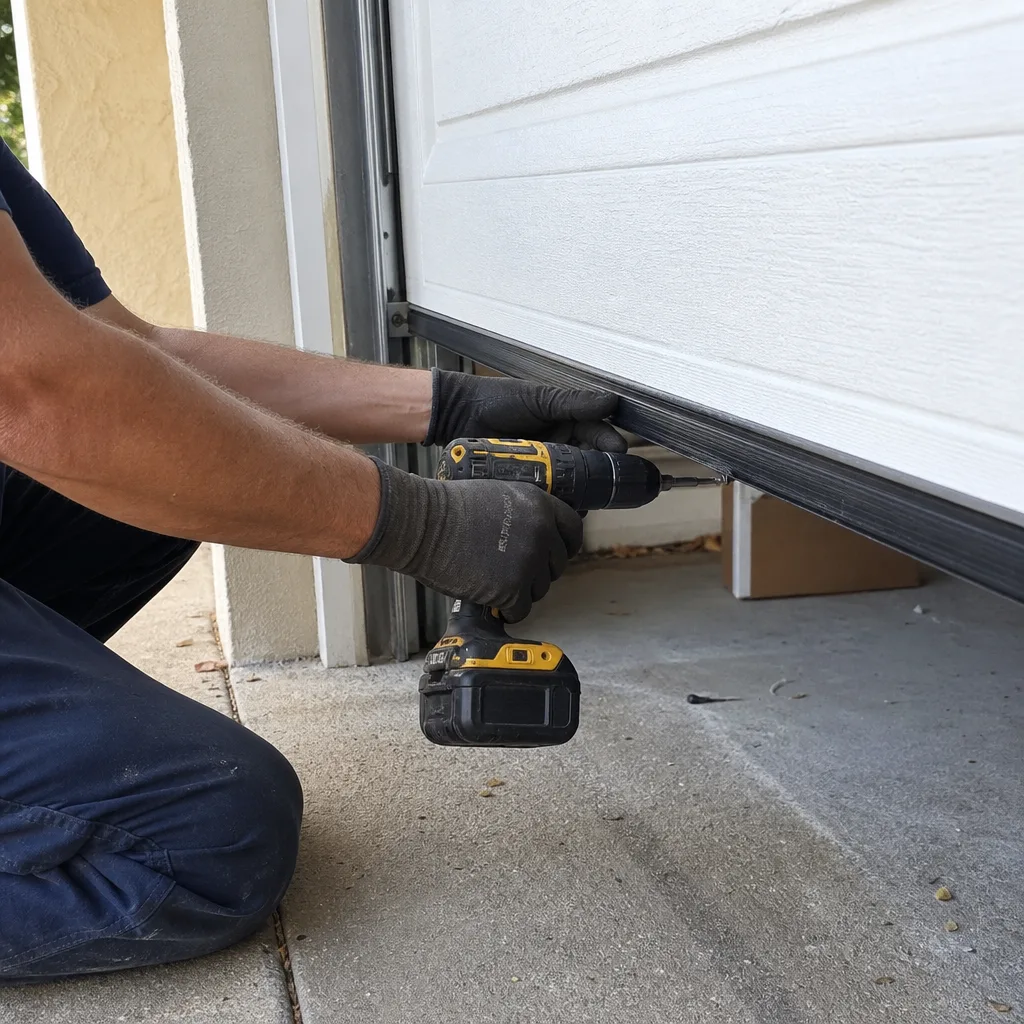
- Weatherstripping and seal: Perimeter weatherstripping goes around the sides and top. The bottom seal is fitted to the floor contour. In Hollywood, gaps at the bottom seal are the first thing that shows up as a rust line on a steel door.
- Opener integration or reinstallation: If the opener is reused, it’s adjusted to the new door’s travel and force settings. If it’s new, it’s programmed, tested, and the outside keypad and remotes are synced.
- Photo documentation and walkthrough: The technician walks you through the installed door, points out what was replaced and why, and delivers a photo record of the finished installation, including any components that were found in failed condition. You leave with documentation, not just a garage door.
Marcus Deller, who owns Servo Garage Doors Hollywood and has run the business since 2015, established the photo documentation rule as a founding practice. The technician photographs the failed component before quoting a replacement. You see what failed. You know why you’re being asked to pay for what’s being recommended. That rule applies to every visit, whether it’s a spring replacement or a full door installation.
Common Mistakes to Avoid
- Buying a non-galvanized steel door near the Intracoastal: It will rust through the bottom panel within two years. Always confirm galvanization, and if you’re within half a mile of salt water, consider aluminum or fiberglass.
- Skipping the wind-load verification: A door without a documented NOA number and design pressure rating may not be code-compliant in Broward County. It’s also a gift to your insurance company if you ever file a storm claim.
- Ignoring the HOA until after purchase: You will wait 30 to 45 days for an architectural review, and a denial sends you back to shopping. Pull the design guidelines before you spend a dollar.
- Replacing the opener when the real problem is rollers or springs: A noisy door is usually rollers. A struggling door is usually a tired spring. Diagnose the cheap fix before shelling out for a new opener.
- Choosing R-value based on northern garage guides: In Hollywood, the thermal threat is heat, not cold. An R-12 to R-16 polyurethane door serves most attached garages perfectly. Higher R-values don’t pay back here.
- Accepting a quote without a written scope: “Call for a quote” is how you get surprised. The price and scope should be written and flat before any work starts, covering parts, labor, haul-away, and tax.
- Installing a standard spring instead of a high-cycle one: If you’re in a house you plan to keep, a high-cycle torsion spring rated at 25,000 to 50,000 cycles costs a little more and lasts years longer. Standard springs are a repeat purchase by design.
When to Call a Professional
A garage door is the heaviest moving object in your home, and several of its components are under enough tension to cause serious injury. Torsion springs should never be handled by a homeowner; the stored energy releases all at once if a spring breaks during adjustment. Cables are similarly dangerous when tensioned. If your door is off its tracks, if a spring has snapped, if a cable is frayed, or if the door falls unevenly, stop using it and call a professional. The same goes for electrical work on the opener if you’re not comfortable with low-voltage wiring.
Less dramatically, any wind-load or HOA compliance question is a reason to bring in someone who does this work in Hollywood daily. Servo Garage Doors Hollywood offers free estimates on garage door work throughout Hollywood, with written pricing before any work starts. Call (754) 465-7645 to schedule a measure. See our Servo Garage Doors Hollywood home page for the full service area and documentation standards.
Frequently Asked Questions
A new single-car garage door in Hollywood typically costs $1,200 to $2,800 installed, and a double door runs $1,800 to $4,500, depending on material, insulation, wind-load rating, and whether your HOA requires specific finishes. The final number is quoted in writing before any work starts. Call (754) 465-7645 for a free measurement and written estimate.
Yes. Hollywood is in Broward County’s High Velocity Hurricane Zone, and Florida Building Code Section 1609 requires garage doors to meet specific design pressure ratings. Your exact rating depends on your home’s location and exposure category, but virtually every garage door sold in Hollywood must be wind-load rated and carry an NOA number.
Salt air damage is measurable up to roughly two miles inland, but the worst corrosion occurs within half a mile of the Intracoastal or the ocean. Homes in that zone should choose aluminum or fiberglass doors with marine-grade hardware, or accept that galvanized steel will have a shorter service life.
Most Hollywood HOA architectural review committees respond within 14 to 45 days. The timeline depends on how often the committee meets; some review monthly. Start the approval process before you schedule installation, and have your installer’s spec sheet and wind-load documentation ready for submission.
A noisy garage door is almost always worn rollers, not a failed opener. Nylon rollers with sealed bearings cost $120 to $200 to replace and quiet the door significantly. Before replacing the opener, have the rollers, hinges, and springs inspected. You may save $300 or more.
No. At Servo Garage Doors Hollywood, the price is quoted in writing after a measure and inspection, and it doesn’t change once work begins. If additional work is discovered during the job, it’s photographed, explained, and quoted separately before anything else proceeds. No surprise invoices. Call (754) 465-7645 for a free estimate.
The Bottom Line
A garage door in Hollywood is a system built against three pressures: salt air eating the materials, wind code governing the hardware, and HOAs shaping the style. Get the material right for your distance from the water, get the wind-load rating documented for your specific address, and get the HOA approval before you buy. The four components that fail most often in Hollywood, springs, cables, rollers, and the bottom seal, are cheap to maintain and expensive to ignore. If you take one action this year, inspect the bottom seal and the rollers. If you take two, get a written quote that names the price, the scope, and the wind-load rating before any work begins. Everything else follows from there.
Written by Marcus Deller, Owner at Servo Garage Doors Hollywood, serving Hollywood since 2015.