
Last updated September 20, 2026
Full 25-point door and opener safety check with every visit - springs, cables, rollers, tracks, and your LiftMaster or Chamberlain opener included
You get a price before we start. It does not change when the truck arrives.
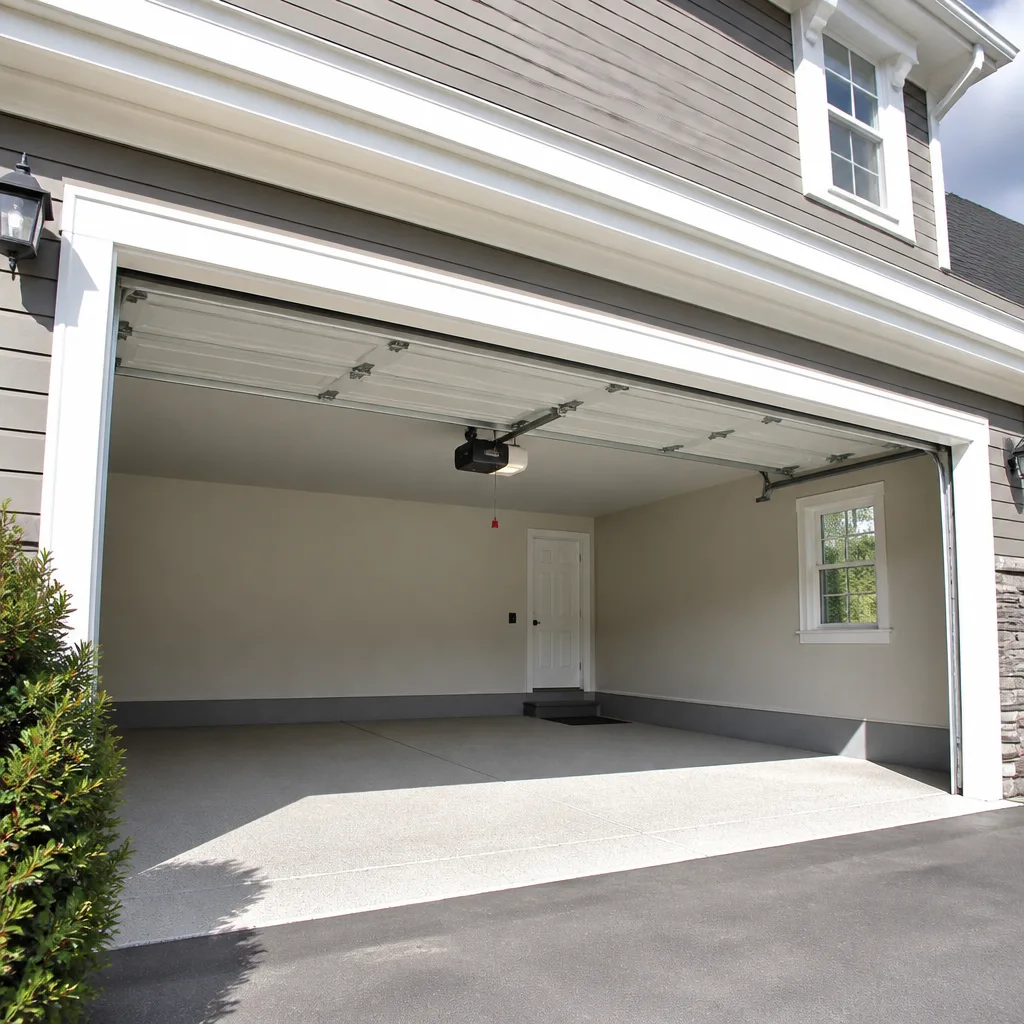
 Before
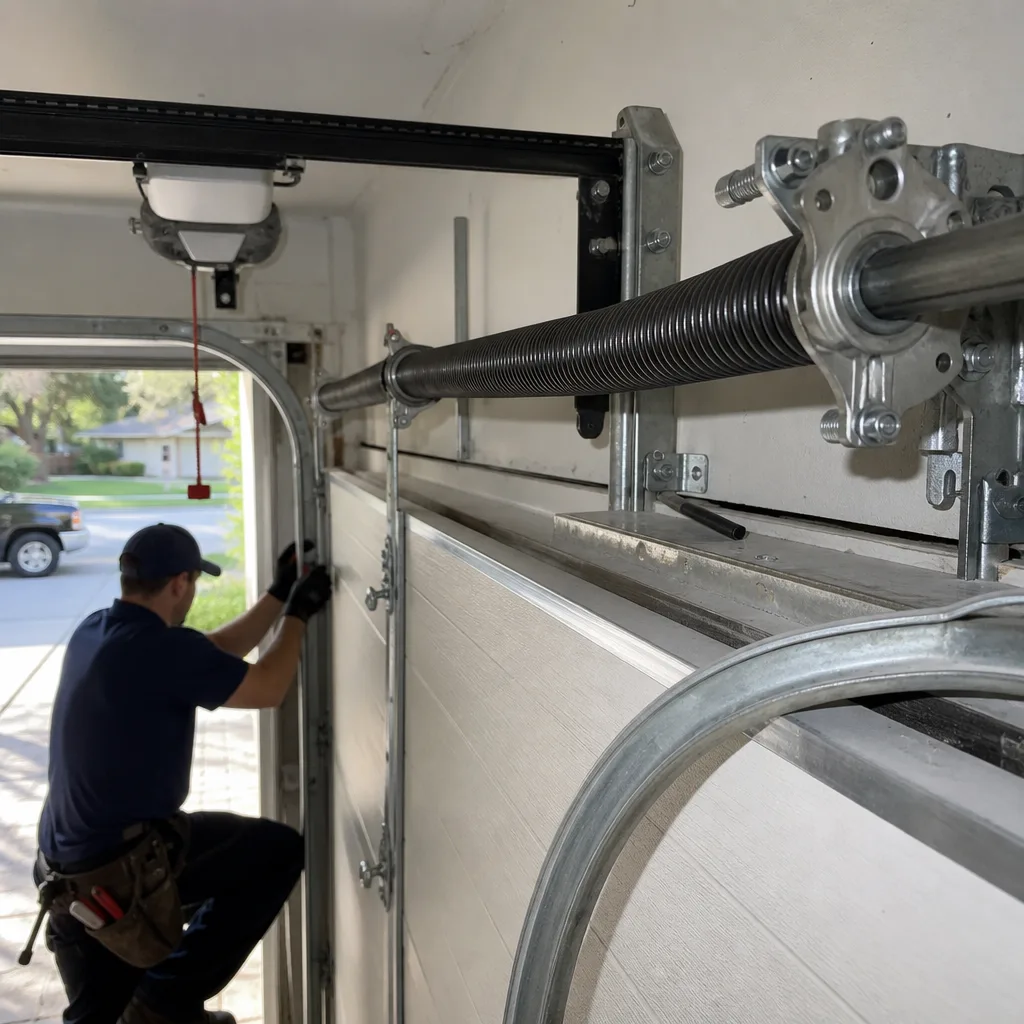 After
After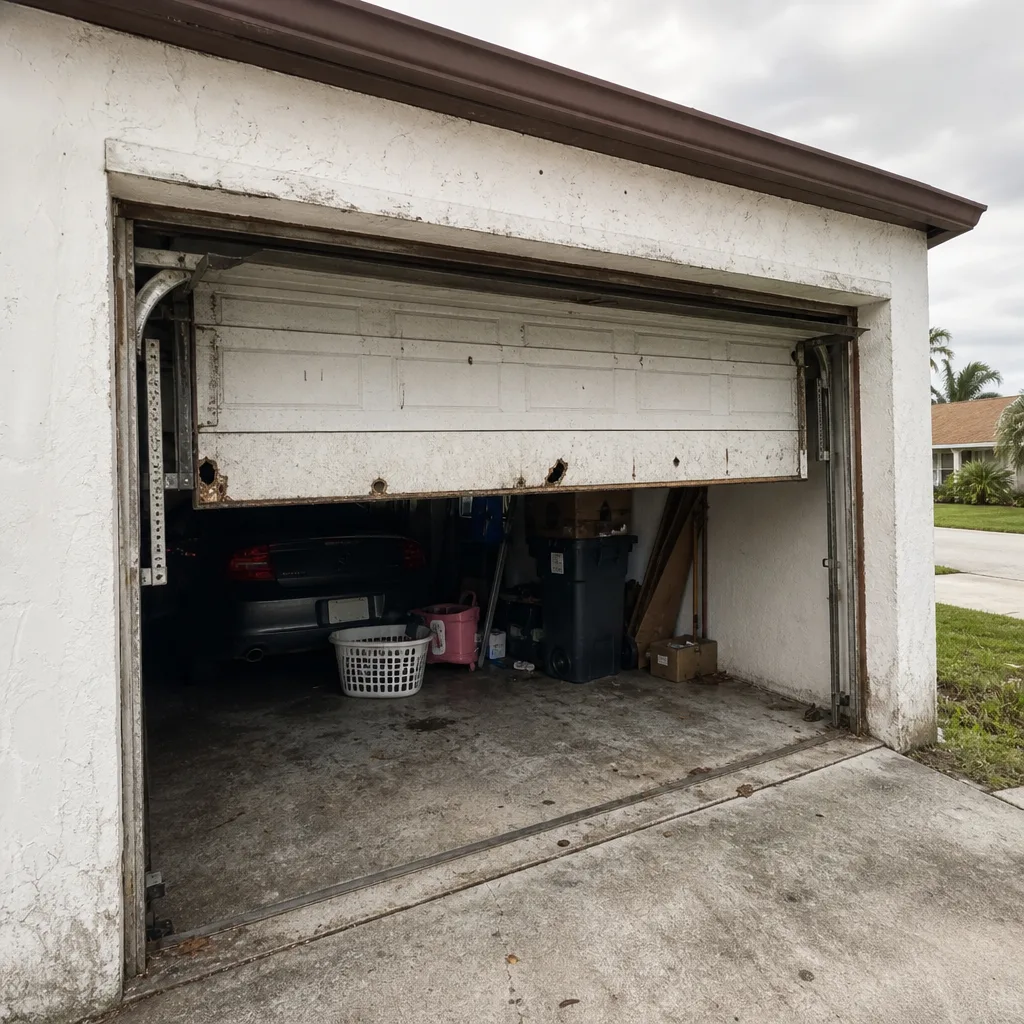 Before
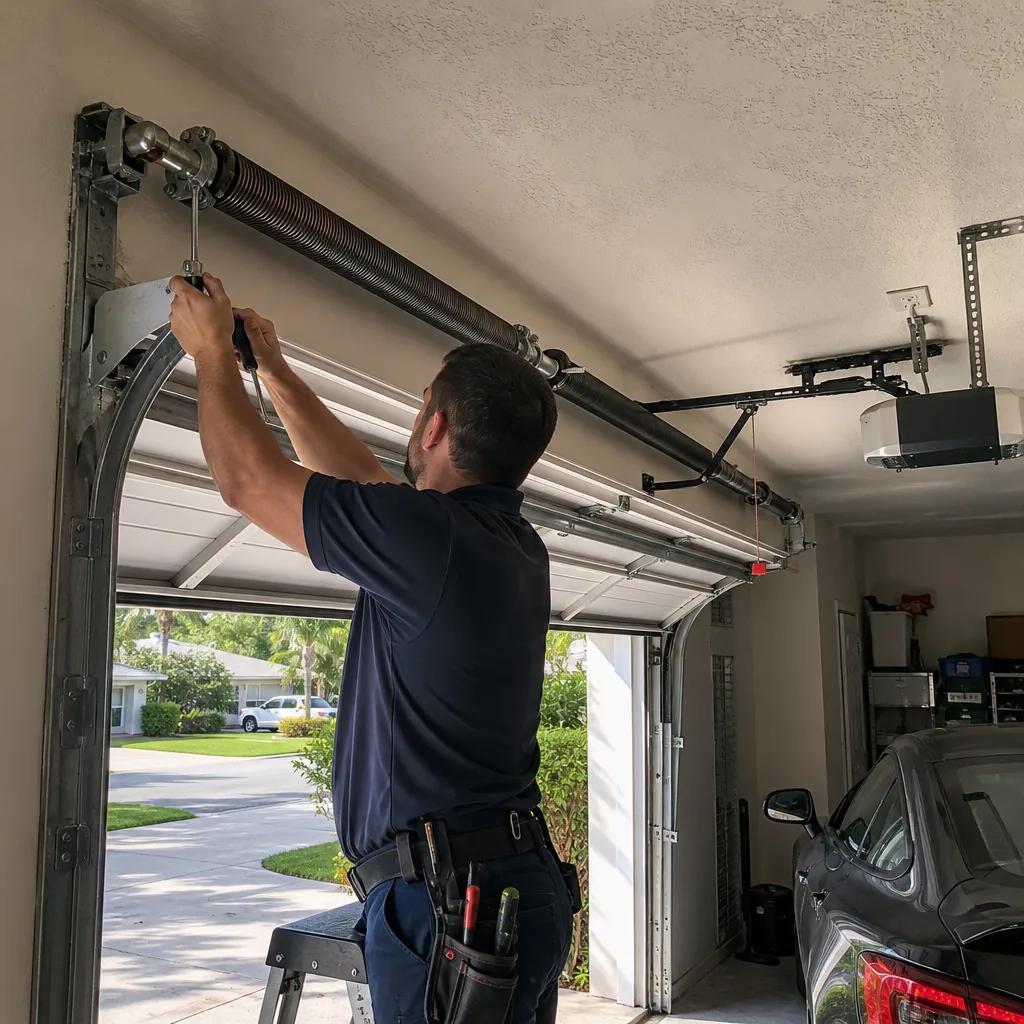 After
After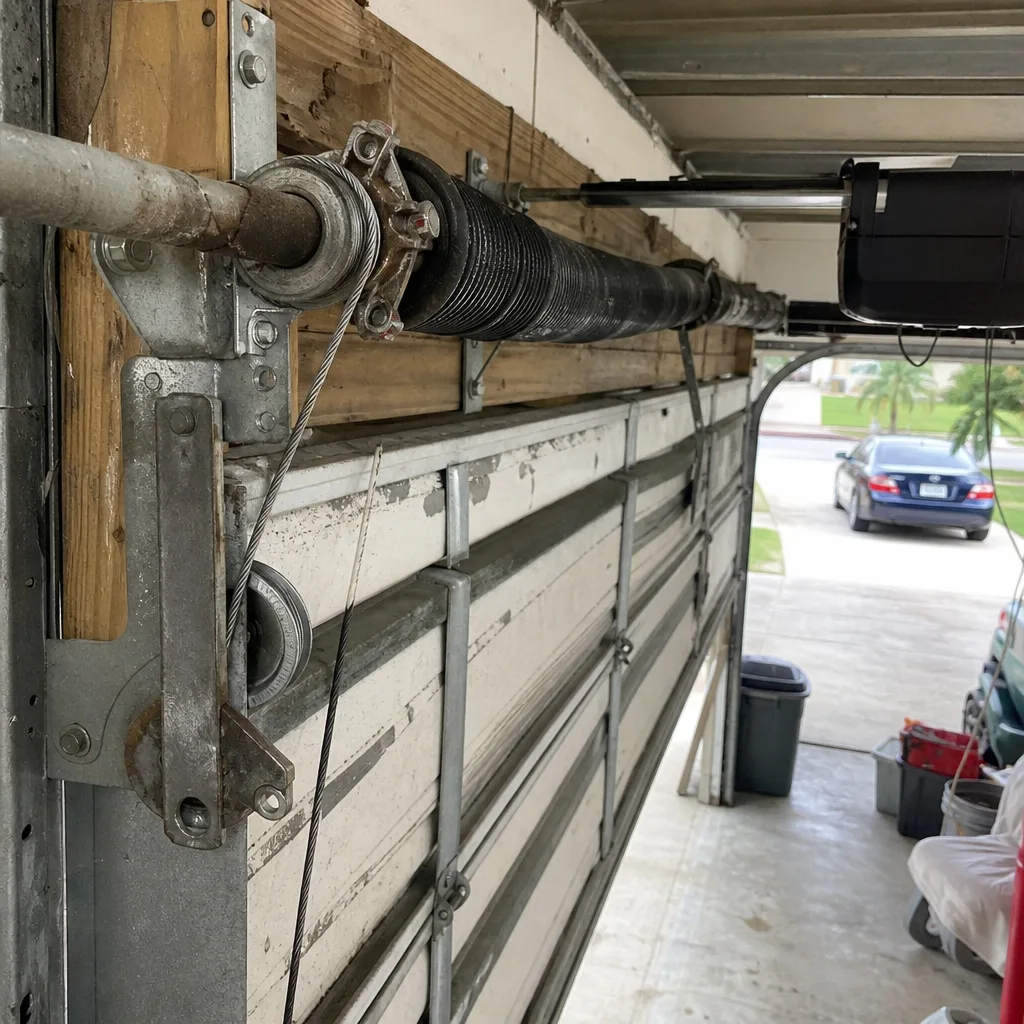 Before
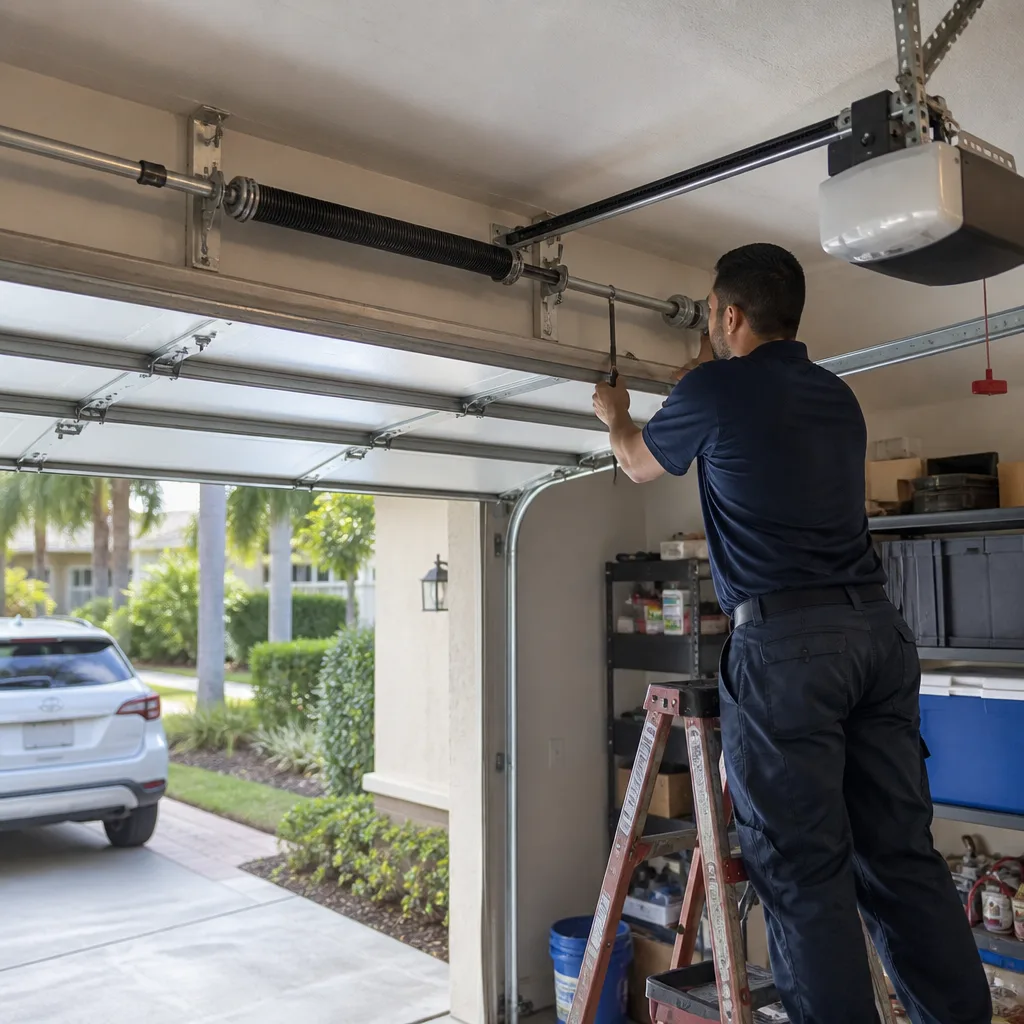 After
AfterDIY vs Professional Garage Door: The Hollywood Homeowner’s Decision Guide
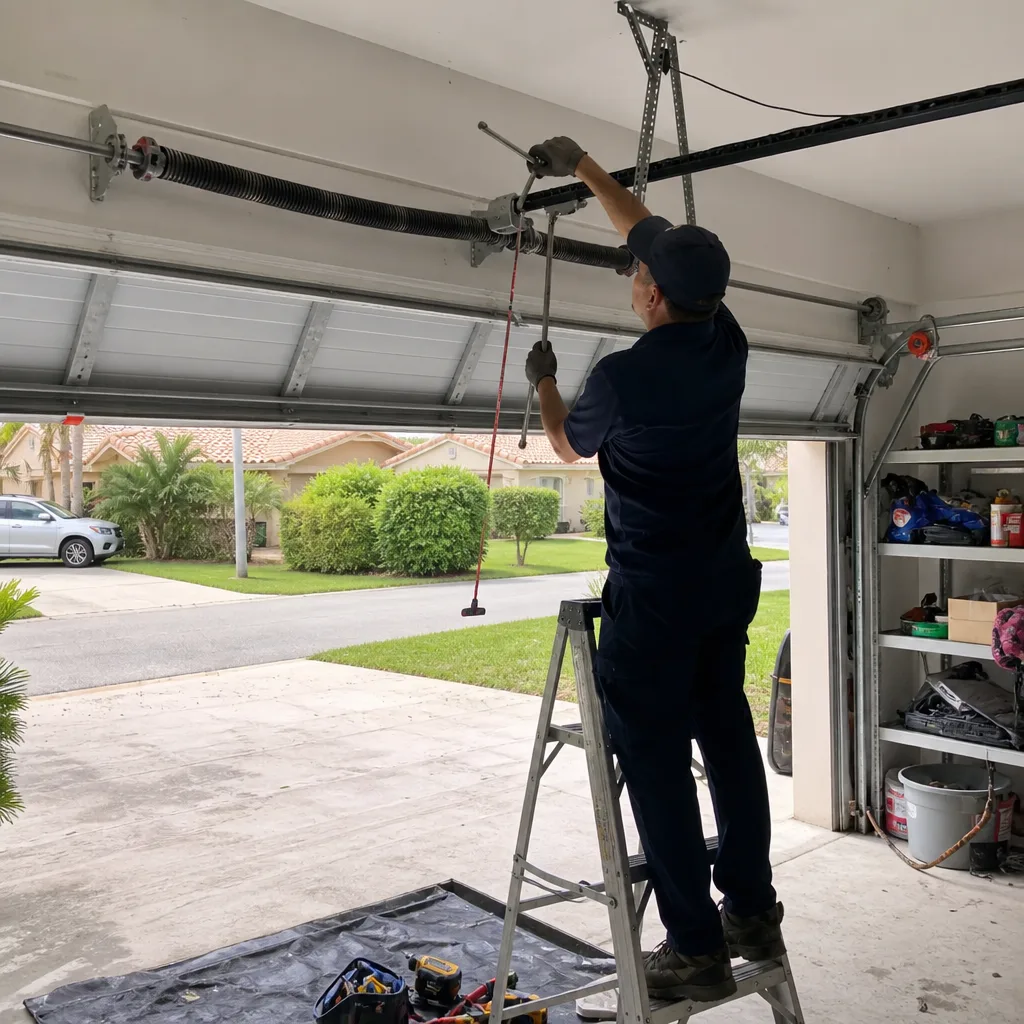
A torsion spring on a standard 7-foot garage door stores roughly 100 foot-pounds of torque per quarter-turn of wind. That is enough stored energy to fracture a wrist or detach a finger if the winding bar slips. The decision to replace one yourself is not a question of skill, confidence, or how many YouTube tutorials you have watched. It is a physics question with one correct answer regardless of how handy you are. This guide draws the line by component, not by courage. We will tell you which four garage door tasks are genuine DIY territory for a Hollywood homeowner, which three are professional-only no matter what the video comments say, what the Florida Building Code actually requires, and what the real cost difference is when you run the math. We’re Servo Garage Doors Hollywood home, and we have repaired enough doors in this city to know exactly where that line sits.
Quick Answer
Most garage door work in Hollywood falls cleanly into one of two buckets. Weather seal replacement, keypad reprogramming, manual lock adjustment, and roller swaps on extension-spring doors are legitimate DIY tasks for a homeowner with standard tools and an afternoon. Torsion spring replacement, cable drum re-winding, and track realignment beyond a quarter-inch are professional-only work that carries real risk of serious injury or worse damage to the door. Before attempting anything, check whether a permit applies: in Hollywood, a new door installation requires one even if you do the work yourself, so review Garage Door Permits, Codes & Inspections in FL: What You Need to Know first.
Table of Contents
- Physics First: The Four DIY Tasks That Are Actually DIY
- The Three Professional-Only Tasks, Regardless of Tutorial Quality
- What the Florida Building Code Says About DIY Door Work in Hollywood
- The Real Cost Math: DIY Roller Replacement vs. a Written Flat Rate
- How to Document DIY Work So a Future Technician Isn’t Starting From Scratch
- Common Mistakes to Avoid
- When to Call a Professional
- Frequently Asked Questions
BeforeAfterPhysics First: The Four DIY Tasks That Are Actually DIY
Here is the boundary in plain terms: if the task does not involve stored mechanical energy or structural load, it is likely within reach. Hollywood’s salty coastal air and summer humidity do accelerate wear on certain parts, which means some of these tasks come up more often here than they would inland. The four that qualify:
1. Weather Seal Replacement
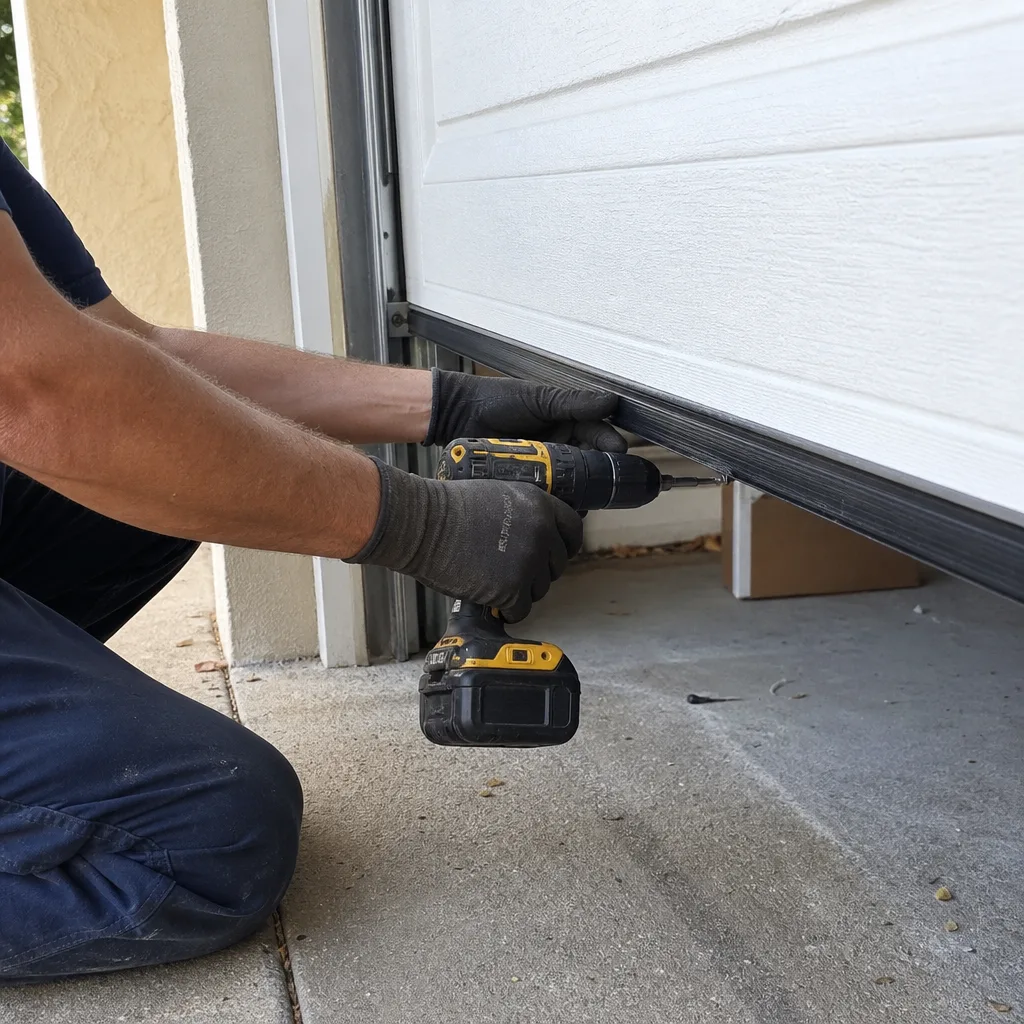
The rubber strip along the bottom of the door, called the astragal or bottom seal, hardens and cracks under Florida sun and salt exposure. It is the most common DIY repair in Hollywood, and it requires no spring tension work. You slide out the old T-shaped seal from the aluminum retainer channel, cut the new one to length with tin snips, and slide it back in. Seals are sold in standard widths at any Hollywood hardware store for $20 to $40. This task takes 20 minutes, requires no tools beyond tin snips and a flathead screwdriver, and carries zero mechanical risk if the door remains in the open position with the opener unplugged.
One Hollywood-specific note: buy a seal rated for UV exposure. The cheaper black rubber seals from big-box stores tend to crack within two years under a western-facing Hollywood afternoon sun. A gray or tan UV-stabilized seal will last noticeably longer on homes west of US-1.
2. Roller Swap on Extension Spring Doors
If your door uses extension springs, the long springs running horizontally along the tracks, you can replace rollers yourself. Nylon rollers with sealed bearings wear out every 3 to 5 years on a door that cycles twice a day, and in Hollywood’s sandy soil, grit accelerates the wear. The rollers fit into hinges along the door’s edge. On an extension-spring door, you can remove the hinge bolts one at a time with the door closed, swap the roller, and re-tighten. Part cost: $4 to $8 per roller for quality nylon with ball bearings. Tool list: 7/16-inch socket, a step ladder, and 30 minutes.
Do not attempt this on a torsion-spring door. The bottom roller brackets on a torsion door carry cable tension, and removing the wrong bolt releases the cable from the drum. That is a professional-only repair, not a Saturday project.
3. Keypad Reprogramming
Keyless entry pads from LiftMaster and Chamberlain live outside in Hollywood’s rain and salt air. When the buttons stop working reliably, it is almost always a logic board or pad failure, not a programming error. But if the pad still lights up and simply stopped opening the door, reprogramming is genuinely DIY. Hold the learn button on the opener motor unit until the LED blinks, enter a new four-digit code on the keypad within 30 seconds, and press enter. This works on most LiftMaster, Chamberlain, Craftsman, and Genie openers sold since 2005. The entire process takes under 5 minutes and costs nothing.
If the keypad does not light up at all, replacing it is still DIY-accessible. A new universal keypad costs $25 to $45 and mounts with two screws. Just know that the opener’s learn button is the access point, and it is on the motor unit itself, which means a ladder, not a service call.
4. Manual Lock Adjustment
Many Hollywood homes built before 1990 still have the center latch lock at the top of the door, even if the opener was added later. If the latch no longer aligns with the strike plate, the fix is usually mechanical, not a replacement. Loosen the two bolts holding the lock body with the door closed, shift it slightly to align with the strike, and re-tighten. A dab of white lithium grease on the sliding bar keeps it smooth. It is a 10-minute fix with a 9/16-inch wrench, and it is one of the few garage door tasks with zero interaction with any spring system.
These four tasks share a boundary condition: none of them touch the torsion spring, the lift cables, or the track structure. That is the dividing line, and it is not negotiable.
The Three Professional-Only Tasks, Regardless of Tutorial Quality
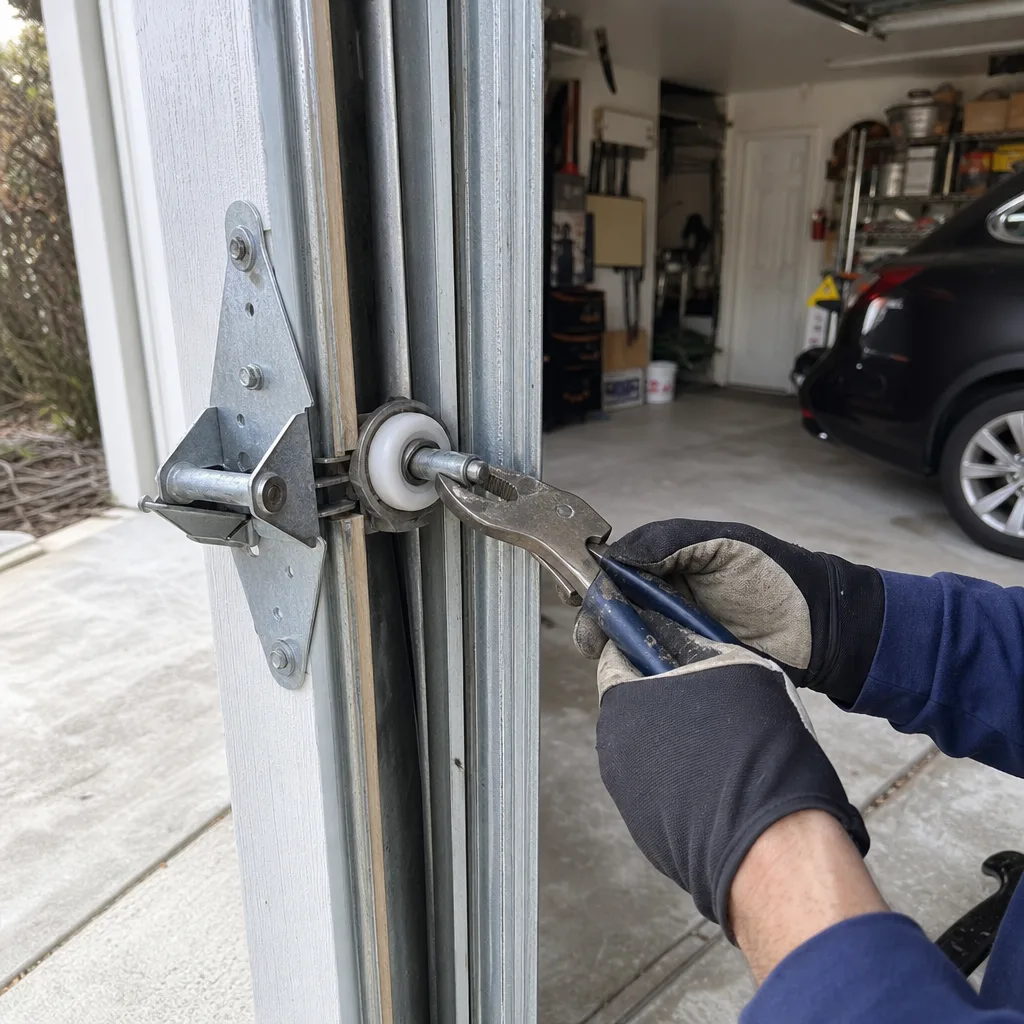
The comment section under a garage door tutorial is filled with people who got lucky. The three tasks below are different because the failure mode is not “the door stops working.” It is a wound spring releasing its energy into whatever is closest, a cable snapping under load and cutting through drywall or skin, or a door leaving its track and coming down on a car, a child, or you. These are the tasks where a Hollywood homeowner should make a phone call, not a Winding Bar purchase.
1. Torsion Spring Replacement
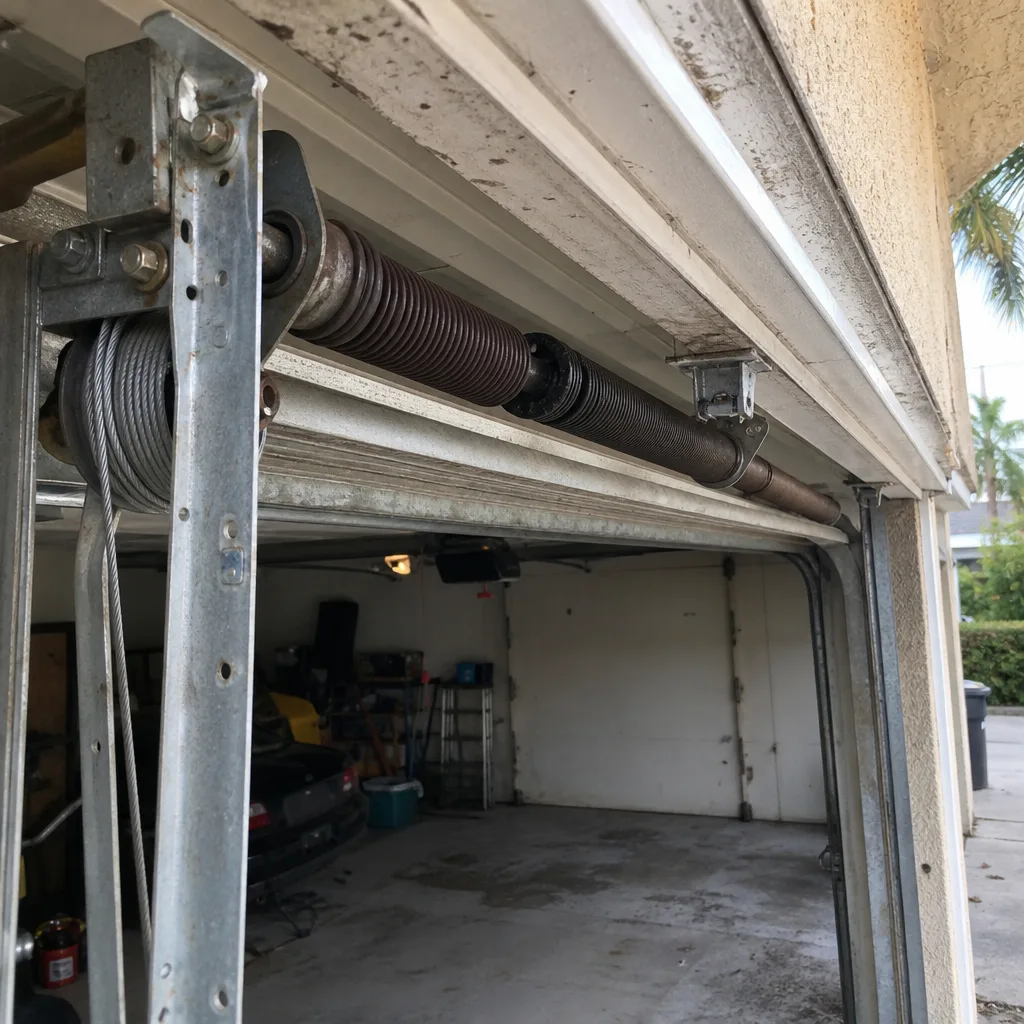
The torsion spring is the coiled steel spring mounted on a bar above the door opening. It counterbalances the door’s weight, which on a double-wide steel door in a Hollywood home is typically 150 to 250 pounds. A broken spring means the opener is now lifting that full weight alone, which is why the door barely moves. Replacing one means unwinding the remaining tension from the unbroken spring (if one remains intact), removing the spring assembly, and winding new springs on the bar to precisely the correct number of quarter-turns for the door’s height and weight. A single miscalculated quarter-turn changes how the door balances, and an unwinding bar slipping mid-wind releases torque at roughly the force of a 200-pound man swinging a baseball bat. We have seen the results in Hollywood garages: fractured forearms, lacerated scalps, and one crushed thumb that ended a woodworker’s career. This is not dramatic. This is what a torque spring does when it is mishandled.
A torsion spring replacement in Hollywood typically runs $180 to $340 per spring, installed, with the parts and labor quoted in writing before any work starts. For a full picture of what this and similar jobs cost, see our Garage Door Cost Breakdown: The Hollywood Homeowner’s Reference for 2026. That price buys the two springs (we replace both on a double-spring door even if one is intact, because the unbroken one has the same cycle life), the balancing, and the documentation that shows what was found and what was done.
2. Cable Drum Re-Winding and Cable Replacement
The lift cables run from the bottom brackets on each side of the door up to the cable drums on the spring bar. They carry the door’s full weight every time it operates. When a cable frays or snaps, the door cannot lift evenly. A snapped cable on one side means the remaining cable takes the full load, and that remaining cable usually fails within days. Fixing it means removing the old cable, mounting the new cable to the bottom bracket, and re-winding the cable drum under correct tension while the door is supported. If the door is not properly braced, the bottom panel can kick violently when the cable is released. A cable under load stores less energy than a torsion spring but drives through more of it, and the injury pattern is hand and wrist trauma. This is professional work. In Hollywood, we see cable failures most often on doors within 2 miles of the Intracoastal, where salt air corrodes the cable strands fastest.
3. Track Realignment Beyond a Quarter-Inch
Vertical tracks on either side of the door guide the rollers. They can bend when a car bumps the door, when a child hangs from a bottom handle, or when the concrete slab shifts, which happens more than people expect on Hollywood’s sandy soil. A track that is out of alignment by a quarter-inch or less can sometimes be addressed by nudging the track bracket with a mallet. Anything beyond that is structural. The track carries the full weight of the door as it travels, and a door that binds mid-travel can jump a roller, twist in the opening, and come down hard. Bending a track back to true without a track gauge and the right jig usually makes the misalignment worse. This is a professional repair, and it is also the one most likely to require a replacement track section if the bend is in the curve.
The shared factor across these three tasks is stored energy. A spring wound to 7.5 turns holds roughly 750 foot-pounds of torque. A cable under tension is a sawing wire. A track under load is a falling object waiting for a reason. None of these care how capable you are. They care if the load is controlled.
What the Florida Building Code Says About DIY Door Work in Hollywood
Hollywood sits in Broward County, which enforces the Florida Building Code through the city’s Building Division. The code is clear on one point that surprises a lot of homeowners: installing a new garage door does not exempt you from the permit requirement just because you are doing the work yourself. Chapter 1 of the Florida Building Code, Building Volume, requires a permit for the installation of a garage door on a residential structure. The work is not “like-for-like maintenance.” It is a structural opening in a wind-rated envelope, and in a hurricane zone, the code treats it accordingly.
What this means in practice for a Hollywood homeowner:
- New door installation requires a permit. Pull it before you order the door. The city will want a product approval number for the door, which is the FL number that certifies the door meets Miami-Dade or Florida Building Code wind-load standards. Big-box doors sometimes lack the right FL approval, which fails inspection.
- Wind-load rating matters in Hollywood. Broward County enforces the High Velocity Hurricane Zone provisions in the eastern portions of the county. If your home is east of Federal Highway, your replacement door likely must meet HVHZ standards, which are stricter than the standard wind-load tables. A door sold as “wind-rated” in a national catalog may not meet the specific Miami-Dade product approval that Hollywood’s inspectors check for.
- A failed inspection means remediation by a licensed contractor. If you install a door without a permit or with an unapproved product, and the city catches it (they catch it when you sell the home or when a neighbor’s permit triggers a review), the remedy is not “take the door down and return it.” The remedy is hiring a licensed contractor to bring the opening into compliance, which usually means a new door and a new permit. The DIY savings evaporate, plus the cost of whatever went wrong.
- Repairs do not require a permit. Replacing springs, cables, rollers, seals, and openers is considered maintenance under the code. No permit needed. This is why the DIY/professional line for repairs is a safety decision, not a code decision, while the line for installations is a code decision, not just a safety decision.
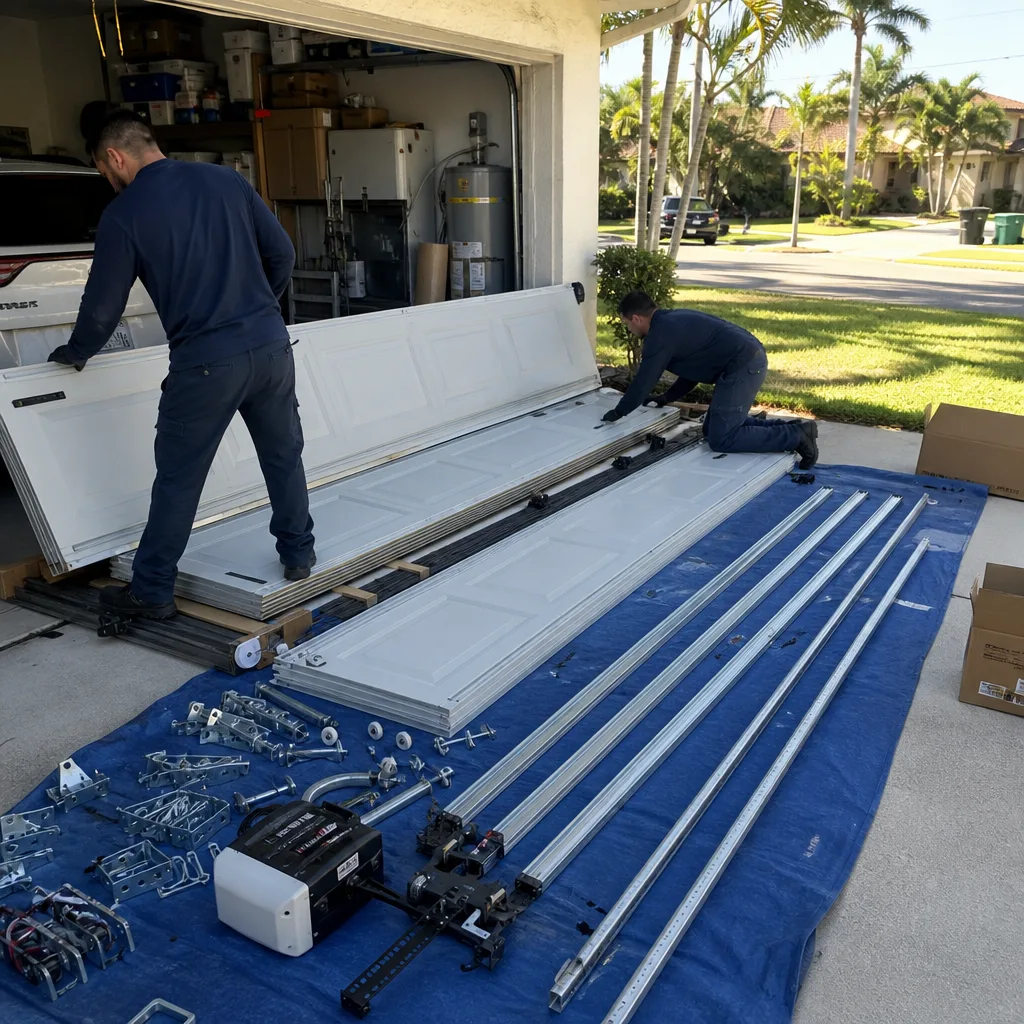
If you are considering a new Garage Door Installation in Hollywood, the code reality is worth sitting with. A permitted installation done right costs more than a weekend swap. But an unpermitted installation that fails inspection costs more than both, and the code does not grandfather mistakes.
The Real Cost Math: DIY Roller Replacement vs. a Written Flat Rate
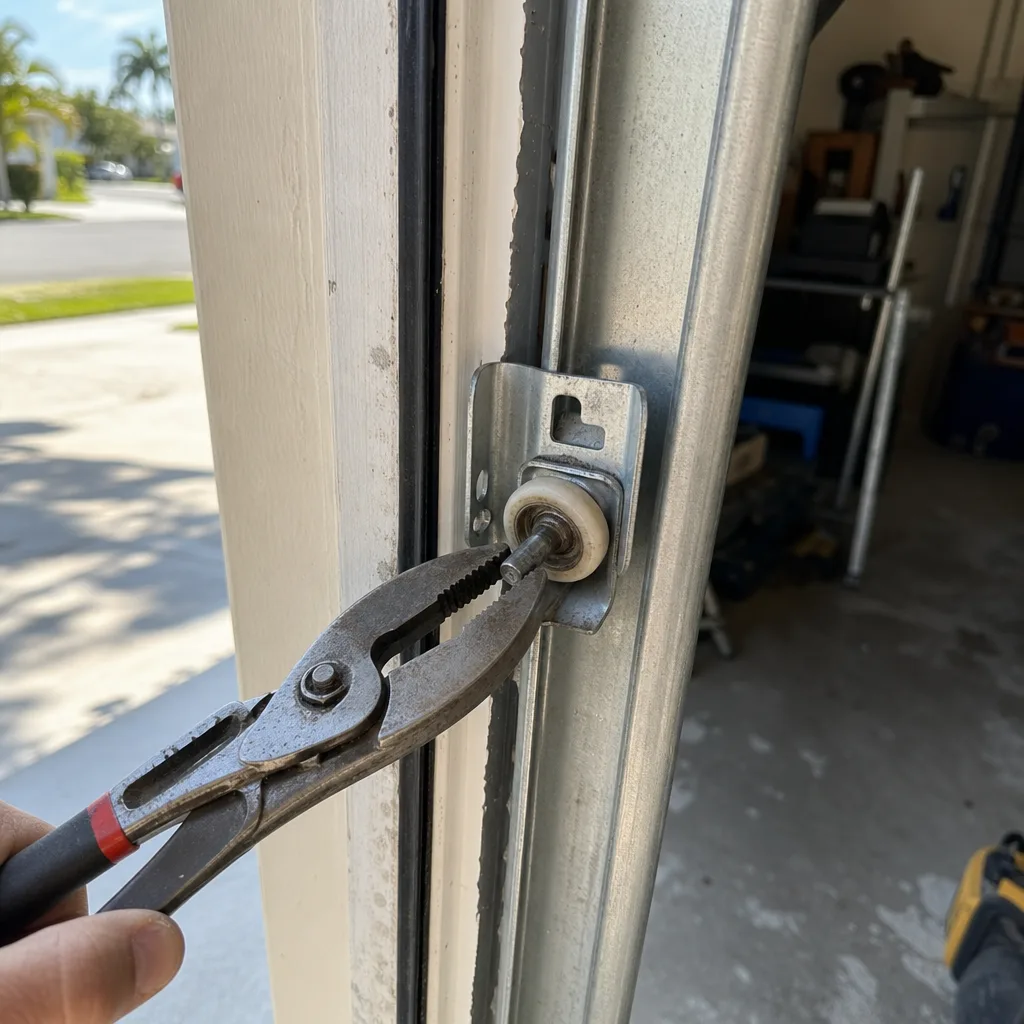
Here is the math on the most common borderline task in Hollywood, a full roller replacement on a double-wide door. We will use current Hollywood market prices, not national averages.
DIY Path
- Parts: 10 nylon rollers with sealed ball bearings at $6 each = $60. (You need 10 for a standard double door: 2 bottom, 2 top, and 6 center hinges.)
- Tools: Assuming you already own a 7/16-inch socket and a step ladder, which most Hollywood homeowners do, $0. If not, add $30 for a socket set and $60 for a ladder.
- Time: 45 to 90 minutes for someone who has never done it, with one caveat: this assumes an extension-spring door. On a torsion door, the bottom roller brackets are under cable load, and this job is not DIY.
- Total cash outlay: $60 to $150 depending on tool ownership.
Professional Path
- Typical flat rate in Hollywood: $120 to $180 for a full roller replacement on a double door, including the rollers, the labor, the balancing check, and the documented photo record.
- Time: 30 to 45 minutes, with the door properly supported and the technician carrying the right rollers on the truck.
The DIY savings here are real but narrow: roughly $60 to $90 in exchange for an hour of your time and the risk of doing it on the wrong spring configuration. For the borderline tasks like this one, the honest answer is that DIY makes sense if you have an extension-spring door, a socket set, and an afternoon. On a torsion-spring door, you are not doing a roller swap, you are doing a cable-release procedure, and the cost of being wrong is not the $60 you saved. It is the full weight of the door coming down on whatever is underneath it.
For comparison, a broken torsion spring is not a borderline task. The DIY path requires winding bars ($40), two springs ($60 to $120), and a full understanding of turn counts and balance weight. The professional path in Hollywood is $180 to $340 per spring, installed, with the price in writing before the work starts. The savings from DIY spring replacement are in the low hundreds, and the downside is measured in reconstructive surgery. That is not a trade a rational homeowner makes.
For any repair you are weighing, theGarage Door Repair in Hollywood price should be on the page before you commit. If a company will not give you a written number before the visit, that is the signal to call someone else.
How to Document DIY Work So a Future Technician Isn’t Starting From Scratch
Every Hollywood home will eventually need professional garage door work. Springs break after 10,000 to 20,000 cycles, openers fail after 7 to 12 years in Florida’s heat and humidity, and tracks go out of true as the slab settles. When that day comes, the technician who answers the call is going to ask what work has been done on the door. If your answer is “I replaced some parts a few years ago, I think,” the technician is diagnosing from scratch, which means more time on site and a less precise quote. A simple documentation habit eliminates that.
Here is what to record when you do DIY garage door work in Hollywood:
- Write down the part numbers. Every roller, seal, keypad, and lock has a manufacturer number printed on it or on its packaging. These numbers tell the next technician exactly what was installed, which matters when a Chamberlain opener needs a logic board that only pairs with a specific keypad revision. Write the number in a notes app or on a piece of masking tape stuck to the opener motor.
- Date the work. Cycle counts are never recorded by homeowners, but a date gives the technician a rough baseline. A spring installed in 2019 on a Hollywood home that cycles four times a day has roughly 10,000 cycles on it. That is relevant when it breaks.
- Photograph the before and after. A photo of the old part before removal shows the wear pattern, and a photo of the new part installed shows the configuration. This matters especially for roller types (nylon vs. steel, sealed bearing vs. unsealed) and seal profiles. Ten seconds with a phone camera saves the next technician 20 minutes of guessing.
- Note the torque or tension settings. If you adjusted anything remotely related to the springs, record the number of quarter-turns you added or removed. This is not a recommendation to touch the springs. It is a record in case you already did. The next technician needs to know what was changed to safely return the door to balance.
This documentation habit is the DIY equivalent of what a professional shop should already be doing. When we leave a Hollywood home, the customer receives a photo record of what was found and what was done, with the part numbers and the date built in. It is Clause 4 of The Haven Standard, the founding rule that a customer sees the failed part before anyone quotes a replacement. Your DIY work can meet the same standard with a phone camera and a notes app.
Common Mistakes to Avoid
- Replacing one spring instead of both. If a double-spring door breaks one spring, the unbroken one has the same age and cycle count as the broken one. Replacing only the broken spring means paying labor twice when the second one fails within months. Replace both, always.
- Buying a big-box door without checking the FL product approval number. Hollywood inspectors check for the Miami-Dade or Florida Building Code approval stamp. If the door lacks it, the permit fails and the door comes down. Check the approval before you buy, not after.
- Lubricating the door with WD-40. WD-40 is a solvent, not a lubricant. It will strip the grease from the rollers and hinges and accelerate wear in Hollywood’s sandy air. Use white lithium grease on metal-to-metal contact points and a silicone spray on the torsion spring, nothing else.
- Attempting a roller swap on the wrong spring configuration. Extension-spring doors allow individual roller swaps. Torsion-spring doors have bottom brackets under cable tension. Removing the wrong bolt releases the cable and drops the door. Know which spring system your door has before you touch a roller bracket.
- Ignoring a door that is balancing wrong because it still opens. If the door drifts up when opened halfway or drops when released, the spring tension is off. A door that opens does not mean it is safe. The imbalance is wearing out the opener gears and will eventually snap a cable or strip the trolley. Fix the balance before it fails catastrophically.
- Doing unpermitted installation work and assuming it will not be caught. The city finds unpermitted garage doors when homes are sold, when insurance claims are filed, and when neighbors pull permits. At that point, the cost to remediate is the cost of a new door, a new permit, and a licensed contractor’s labor. The savings DIY installation promised are gone.
When to Call a Professional
Call a professional if the broken part is under load: a torsion spring, a lift cable, a spring bracket, or a track that has moved more than a quarter-inch. Call a professional if the door is stuck open or stuck closed and you cannot identify why, because forcing a door under tension risks damage and injury. Call a professional if your door was installed without a permit and you want to bring it into compliance before you sell the Hollywood home. Call a professional if the opener is making a grinding noise that is not the rollers, because that is often the gear and sprocket assembly inside the motor unit, which is replaceable but not DIY-friendly on modern openers. And call a professional if you have already attempted a repair and the door is worse than when you started. That is not a failure. That is evidence, and a good technician will work with what you learned. Servo Garage Doors Hollywood offers free estimates in Hollywood - call (754) 465-7645 and get a written number before any work starts.
Frequently Asked Questions
No. Torsion springs store roughly 100 foot-pounds of torque per quarter-turn, and a spring wound for a standard 7-foot door holds 700 to 800 foot-pounds of stored energy. The winding process requires specialized bars and exact turn counts, and a slip during winding releases that energy against whatever is holding the bar, usually your hand or forearm. This is not a skill question. It is a risk question with one answer.
Four tasks are genuine DIY on a Hollywood garage door: weather seal replacement along the bottom channel, roller swaps on extension-spring doors only, keypad reprogramming using the opener’s learn button, and manual lock adjustment. None of these involve stored spring energy or cable tension. Any task that touches a torsion spring, lift cable, or track alignment is professional work.
Yes. The Florida Building Code requires a permit for residential garage door installation, and the Hollywood Building Division enforces it. The door must carry a valid FL product approval number that meets Miami-Dade or Florida Building Code wind-load standards, and if your home is east of Federal Highway, HVHZ standards likely apply. A failed inspection requires a licensed contractor to remediate the opening.
Torsion spring replacement in Hollywood typically runs $180 to $340 per spring, installed, with the price quoted in writing before the work begins. Most double-spring doors should have both springs replaced at the same time. The final number depends on the spring’s wire diameter, length, and whether a center bearing plate or cable drum also needs replacement. Call (754) 465-7645 for an exact quote for your door - the price is written before any work starts.
Plan on 45 to 90 minutes for a full roller replacement on a double-wide extension-spring door if you have never done it before. The job requires a 7/16-inch socket, a step ladder, and 10 nylon rollers with sealed bearings. On a torsion-spring door, do not attempt this: the bottom brackets are under cable tension, and removing the wrong bolt releases the cable. That job belongs to a professional.
If the opener motor runs but the door does not move, the most common cause is a broken torsion spring, which means the opener is trying to lift the full weight of a 150 to 250-pound door without counterbalance. The second most common cause on Hollywood homes is a stripped gear inside the opener unit, which happens when the opener keeps running against a door that is not balanced. Stop using the opener immediately and have the door inspected. Running the opener against a broken spring or stripped gear wears out the gear assembly and can damage the top panel. For Garage Door Opener Repair & Installation in Hollywood, the diagnostic begins with the spring, not the opener.
The Bottom Line
The DIY versus professional decision for a Hollywood garage door is not about how handy you are. It is about what the part is doing when you touch it. A weather seal is doing nothing. A keypad is doing nothing. A lock latch is doing nothing. A roller on an extension-spring door is doing nothing, but the same roller on a torsion-spring door is holding cable tension. A torsion spring is holding 700 foot-pounds of torque. A lift cable is holding the full weight of the door. A track is holding the whole assembly in true. The line is not about confidence. It is about load. Know which side of the line you are on, document what you do, check the Florida Building Code before installing anything, and when the part is under load, call someone who carries written pricing and a camera. That is the entire decision, and it is simpler than the internet makes it sound.
Written by Marcus Deller, Owner at Servo Garage Doors Hollywood, serving Hollywood since 2015.